'Americans Only Copy and Steal' — China's Favorite New Delusion
There's a screenshot making the rounds on Reddit's r/Sino — a Chinese-nationalist echo chamber that makes Fox News look like NPR — and it's pure, uncut cope dressed up as geopolitical analysis. The claim: "Americans only copy and steal."

Yes, you read that correctly. In a timeline where DeepSeek (深度求索) just dropped an open-source model that benchmarks suspiciously close to GPT-4, where Douyin (抖音) was TikTok before TikTok was cool, and where every second livestream on Xiaohongshu (小红书) features someone unboxing a "original design" product that's one AliExpress search away from a lawsuit — the Chinese internet has decided that AMERICA is the real copycat.
The iron-y is thick enough to build a bridge.
Let's be clear about what's actually happening here. This isn't analysis. It's cope — the kind of aggressive, performative cope that emerges when a culture collectively realizes it's still playing catch-up in categories that matter. The r/Sino crowd isn't tracking Chinese AI labs or consumer-internet trends. They're curating a narrative.
And look, there's a kernel of truth buried in the nonsense. American tech companies absolutely do copy features. Facebook (now Meta) ripped Stories from Snapchat. Microsoft Teams exists because Slack existed first. Every tech company in Silicon Valley has a "fast follower" strategy. Apple didn't invent the smartphone, the tablet, or the smartwatch — it perfected them after watching others fail first.
But here's where the Chinese nationalist narrative collapses: the United States still generates the foundational research, the architectural breakthroughs, and the paradigm shifts that everyone else — including China — builds upon.
GPT-4 wasn't a copy. The Transformer architecture wasn't stolen. The iPhone wasn't a response to some Chinese original. These were genuine innovations that created entirely new categories.
Meanwhile, let's examine China's "innovation" track record in the spaces this blog actually covers:
AI Models: DeepSeek (深度求索) is impressive — genuinely impressive. Its open-source MoE architecture and cost-efficient training represent real engineering. But let's not pretend it emerged in a vacuum. The entire Chinese AI ecosystem — from Qwen/Tongyi (通义千问) at Alibaba to Doubao (豆包) at ByteDance to Kimi (月之暗面/Moonshot) to GLM/Zhipu (智谱清言) — is built on top of architectural foundations laid by OpenAI, Google, and Meta. The Transformer paper came from Google Brain. RLHF was pioneered in Western labs. Chinese labs have gotten very good at optimization, efficiency, and deployment. That's valuable! But it's not the same as fundamental invention.
Robotics: Unitree (宇树科技) makes incredible humanoid robots. The H1 and G1 models are legitimately competitive. Fourier (傅利叶) GR-1 is turning heads. But Boston Dynamics existed first. The concept of dynamic balancing, the gait algorithms, the whole field of humanoid locomotion — these were developed primarily in American and Japanese labs. Chinese companies are executing faster and cheaper, which is its own form of genius, but they're building on established foundations.
Consumer Internet: Douyin (抖音) pioneered short-form video. Full credit. But WeChat wasn't the first super-app — that concept emerged from Japan's Line and Korea's Kakao. Pinduoduo (拼多多) built a novel social commerce model, but e-commerce itself? Amazon. eBay. Alibaba's own Taobao (淘宝) was an eBay clone that won because local execution, not local invention.
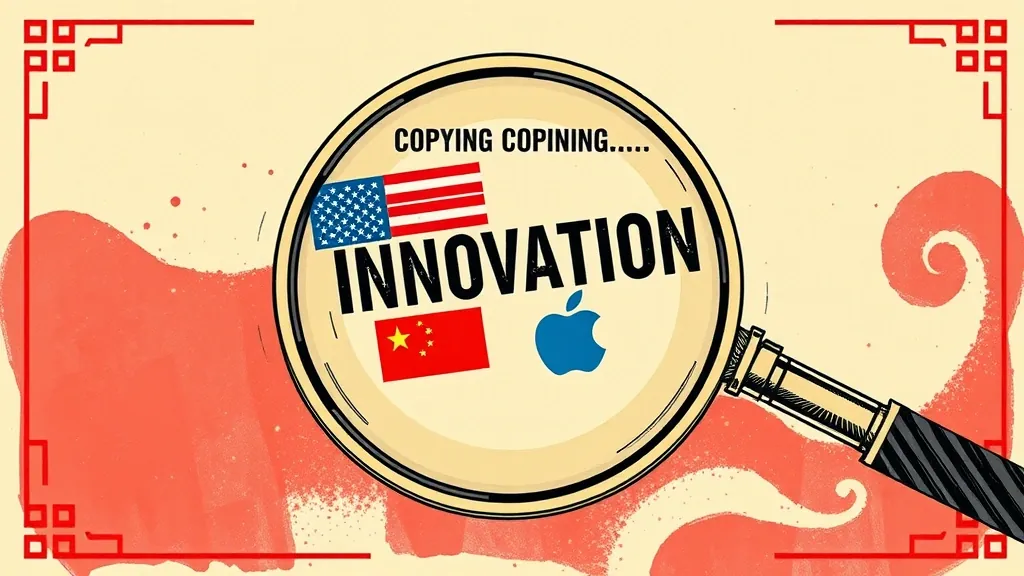
The actual story of Chinese tech isn't theft — it's accelerated iterative improvement at scale. Chinese companies take existing concepts, apply ruthless execution, leverage massive domestic markets for rapid testing, and often produce versions that are better-adapted to real-world use. That's not nothing. That's arguably the most important skill in the modern tech landscape.
But the r/Sino crowd can't handle that nuance. They need a narrative where China leads and America follows. So they cherry-pick examples of American "copying" while ignoring the massive pipeline of innovation that still flows predominantly West to East.
What's actually revealing about this moment is the insecurity it exposes. Confident cultures don't need to insist they're the real innovators. They just... innovate. South Korea didn't become a cultural powerhouse by claiming Americans stole K-pop. Japan didn't dominate consumer electronics by insisting the Walkman was a response to some American original.
China's tech ecosystem is genuinely becoming world-class. DeepSeek's cost-efficient training, Unitree's robot dogs at consumer price points, the entire livestream-commerce revolution — these are real achievements. But they exist within a broader innovation ecosystem that is still fundamentally Western-led at the architectural layer.
The healthiest thing for Chinese tech would be to own its actual strengths — speed, scale, deployment efficiency, and increasingly sophisticated engineering — without needing to rewrite history. The "Americans only copy and steal" narrative isn't just wrong. It's counterproductive. It encourages complacency by telling Chinese companies they've already won the innovation war when they've really just won the optimization battle.
And for global observers watching the actual Chinese internet — not the nationalist-curated version, but the real one on Weibo (微博) and Bilibili (B站) — the signal is clear: Chinese netizens are simultaneously proud of domestic achievements AND aware of the gaps that remain. The r/Sino crowd represents a loud minority, not the mainstream.
The real story? China doesn't need to be the "original inventor" to win. It just needs to keep doing what it's doing: building faster, shipping sooner, and iterating relentlessly. That's a more honest — and ultimately more powerful — narrative than pretending the country that gave the world the Transformer architecture is somehow the real copycat.
Stay honest, folks. The data doesn't care about your feelings.