Car Sinks for Hours, Owner Asks AI to Turn Off Lights
Something is deeply, beautifully unhinged about the way Chinese consumers have integrated AI into their lives, and a Toutiao (今日头条) headline trending at nearly 8 million views just crystallized it perfectly.
The story: a car plunges into water. The driver is trapped inside for hours. And what does this person do with their presumably limited time on Earth? They call out to their in-car voice assistant — to turn off the headlights.
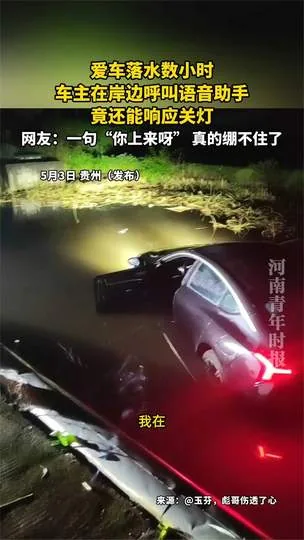
Let that marinate.
Not "call emergency services." Not "send my location to loved ones." Not even a dignified scream into the void. This human, submerged and staring down mortality, prioritized turning off the lights. The most passive-aggressive act of energy conservation in automotive history. Your honor, peak China tech brain.
Now, we don't cover cars at qipaobuzz — that's hype404's lane. But this isn't a car story. This is a story about what happens when voice assistants become so seamlessly woven into Chinese daily life that they've replaced basic survival instincts. The car could've been anything. The point is the reflex.
The voice assistant as phantom limb
China's consumer AI ecosystem has reached a saturation point that western observers still underestimate. When Toutiao (今日头条) users scroll past headlines like this without blinking, it's because the underlying reality — that you can bark commands at a machine and it just works — has become banal. Bilibili (B站) commenters probably laughed, but not because the concept is alien. Because it's relatable.
Think about the layered absurdity: this person's fight-or-flight response routed through a voice UI. That's not a tech failure. That's a success metric the product managers at ByteDance (字节跳动) or Baidu (百度) probably never planned for but would absolutely put in a pitch deck. "Users engage with our assistant even in near-death scenarios." Slide 47. Series C.
The brand of voice assistant isn't specified in the trending headline, which is almost more telling. It could be Alibaba's (阿里巴巴) voice tech, or Baidu's Xiaodu (小度), or any number of in-car systems now standard across Chinese vehicles. The point is that it doesn't matter which one. They're all good enough. They're all there. The ambient intelligence layer is complete.

What this says about China's AI comfort zone
Western discourse around AI assistants still oscillates between "creepy surveillance" and "lazy gimmick." China passed both checkpoints around 2022 and arrived somewhere far more interesting: procedural indifference. The technology is neither feared nor celebrated. It's just... infrastructure. Like tap water. You don't think about it until you're drowning in a car and need it to kill the beams.
This is the real AI adoption gap nobody talks about. It's not about benchmark scores or parameter counts. It's about whether your grandma reflexively talks to her rice cooker. In China, she does. And she's been doing it since Tmall Genie (天猫精灵) launched in 2017 for like 99 RMB. Eight years of ambient voice-AI conditioning will do that.
The driver in this story didn't think "I'm using AI." They thought "lights off" the same way you'd think "breathing." The assistant is no longer a tool. It's a cognitive prosthetic. And when China's consumer-AI market has been running at that integration level for the better part of a decade, you get stories like this — not as anomalies, but as logical endpoints.
The dark comedy of Chinese viral moments
There's also a distinctly Chinese internet-culture angle here. Toutiao's hot board loves this specific genre of story: absurd technology encounters with mortality. Remember the guy who livestreamed his own rescue? The delivery driver who completed an order while his scooter was on fire? Same energy. The internet doesn't gawk at the danger. It gawks at the priorities.
Weibo (微博) and Douyin (抖音) will inevitably mine this for content. Expect "turn off the lights" to become a meme. Expect someone on Bilibili to make an animated short. Expect Xiaohongshu (小红书) influencers to post "what I'd ask my voice assistant in a sinking car" listicles by Wednesday.
And honestly? That's healthy. China's internet culture processes trauma through absurdist humor the way Japan processes it through kawaii. It's a coping mechanism scaled to 1.4 billion people. The fact that the top comment ecosystem can find the comedy in a near-death experience — without being cruel — says something about the emotional fabric of Chinese digital life that no whitepaper will capture.
The real takeaway
Everyone writing about Chinese AI is focused on DeepSeek (深度求索) and Qwen (通义千问) and the great LLM benchmark wars. Fine. Important. But the actual story of Chinese AI is this: a person underwater, seconds from potential death, instinctively calling out to a machine. Not because it's smart. Because it's there. Because in 2026 China, talking to AI is as natural as talking to yourself — except the AI actually listens.
The benchmarks don't measure this. The funding rounds don't capture it. But it's the most honest metric of AI adoption I've seen all year.
Now if you'll excuse me, I need to ask my voice assistant to draft my will.