14nm Is Not 4nm: China's Great Chip Reality Check
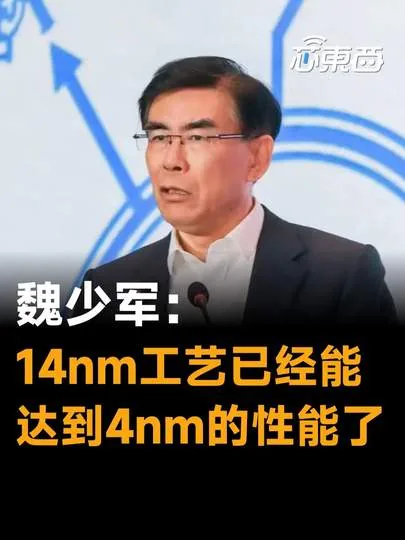
A semiconductor expert just asked the question every Chinese chip romantic has been dreading: "On what basis can 14nm be equivalent to 4nm?" At 17.8 million热度 on Toutiao (今日头条), it's one of the hottest trending stories in China today — and it cuts straight into the most sensitive nerve in the country's tech discourse.
Here's the setup. As China pushes hard toward semiconductor self-sufficiency, a growing chorus of chip companies, tech influencers, and state-adjacent media have been making increasingly bold claims about domestic chip capabilities. The most audacious? That chips manufactured on mature 14nm process nodes — the best widely available to Chinese foundries — can somehow deliver performance "equivalent to" TSMC (台积电) or Samsung 4nm silicon through clever design, advanced packaging, or software optimization.
Now an actual expert has stood up and said: prove it.
The 14nm-to-4nm Magic Trick
The "equivalence" claim rests on a few technical pillars. First, there's advanced packaging — techniques like chiplets, 2.5D integration, and through-silicon vias that let you stitch together multiple chips made on older processes to theoretically match performance of a single cutting-edge die. Second, there's architectural optimization — smarter logic circuits, improved cache hierarchies, more instructions per clock. Third, there's the ancient art of just clocking the thing higher and praying thermals save you.
Companies like Huawei (华为), through its HiSilicon (海思) division, sit at the center of this narrative. The Kirin 9000S that powered Huawei's smartphone comeback was reportedly manufactured by SMIC (中芯国际) on what's widely believed to be a 7nm-class process — a genuine achievement given the constraints. But even that chip doesn't match the performance or efficiency of TSMC's 4nm-class silicon in contemporary Qualcomm (高通) or MediaTek (联发科) mobile processors.
The expert's frustration resonates with many in China's semiconductor community who worry that overhyping domestic chip capabilities does more harm than good. If 14nm is already "equivalent to 4nm," then why invest in the excruciatingly difficult work of actually advancing process technology? Why chase EUV alternatives? Why push for 5nm, 3nm, 2nm?
The Internet Reacts
The Toutiao comment section is a warzone. On one side: techno-nationalists who see any criticism of Chinese chips as a foreign-orchestrated smear campaign. On the other: engineers who've actually worked in fabs and know that process node numbers represent fundamental physical capabilities — transistor density, power efficiency, switching speed — not marketing labels you can rebrand.
"You can optimize architecture, but you can't cheat physics," reads one top comment with over 50,000 likes. "14nm transistors are physically larger and leakier than 4nm transistors. No amount of packaging magic changes that."
Another banger: "This is like saying a tuned Honda Civic is 'equivalent to' a Ferrari because it hits the same top speed. Sure, maybe. But the Ferrari does it at half the fuel consumption and a quarter the heat."
But the counter-attack is fierce. "Western media said we couldn't make 7nm either. Look where we are now," writes one user. "The expert is either naive or has an agenda."

What This Really Reveals
This debate isn't just about semiconductors. It's about two competing narratives that define Chinese technology discourse right now.
The first — call it "leapfrog optimism" — holds that China can skip intermediate steps and jump directly to the frontier through engineering creativity and sheer national mobilization. It's the same energy behind DeepSeek (深度求索), which achieved near-frontier AI model performance on a fraction of the compute budget Western labs used. It's the spirit behind Unitree (宇树科技) selling humanoid robots for under $16,000 when Western counterparts cost multiples more. China's entire 2024 tech zeitgeist is built on the belief that constraints breed creativity and that being denied the cutting edge forces you to find alternate paths to the same destination.
The second narrative — "engineering realism" — holds that some gaps are fundamental, not just matters of will or money. You can't optimize your way around transistor physics. You can't chiplet your way to power efficiency that's baked into the manufacturing process itself. Pretending otherwise risks building a Potemkin village of "domestic substitution" (国产替代) that collapses under real competition.
Both narratives are partially right. DeepSeek's R1 genuinely shocked the AI world by proving algorithmic innovation can partially compensate for compute limitations. SMIC's 7nm production was a real milestone most analysts thought was years away. Cambricon (寒武纪) and Moore Threads (摩尔线程) are pushing genuine boundaries within constraints. But none of that means 14nm equals 4nm.
My Take
The expert is correct. 14nm is not 4nm. Claiming otherwise is marketing dressed as engineering.
But here's where it gets dangerous: marketing has consequences. When Chinese chip companies overpromise and underdeliver, they don't just embarrass themselves — they erode trust in the entire domestic semiconductor ecosystem. Investors burned by overhyped startups become skeptical of genuinely promising ones. Consumers who bought "equivalent to 4nm" phones that throttle under load and incinerate batteries become cynical about all domestic tech.
The path forward isn't pretending 14nm is something it isn't. It's acknowledging the gap honestly, closing it one process node at a time, and celebrating real achievements without the magic math.
China's tech story this year is extraordinary enough without inflating numbers. DeepSeek already proved that. Now the chip industry needs its own DeepSeek moment: less hype, more honesty, and the quiet confidence that comes from knowing exactly where you stand — and exactly how far you have left to climb.