China's 'No Water' Ice Cream Exposed as… Mostly Water
Nothing hits quite like a Chinese summer — the sticky humidity, theprt mosquitos, and the collective national pastime of discovering that yet another beloved consumer product has been lying to your face.
The latest victim of China's internet-driven accountability machine: a premium ice cream brand that built its entire identity on the bold claim 「不加一滴水」 — "not a single drop of water added." Sounds luxurious. Sounds pure. Sounds like something worth paying 15-20 RMB for at a convenience store freezer instead of the 3 RMB basic popsicle. Except someone flipped the package over and read the ingredients list. The very first ingredient — meaning, by Chinese labeling law, the most abundant component by weight — was, you guessed it, water (水).
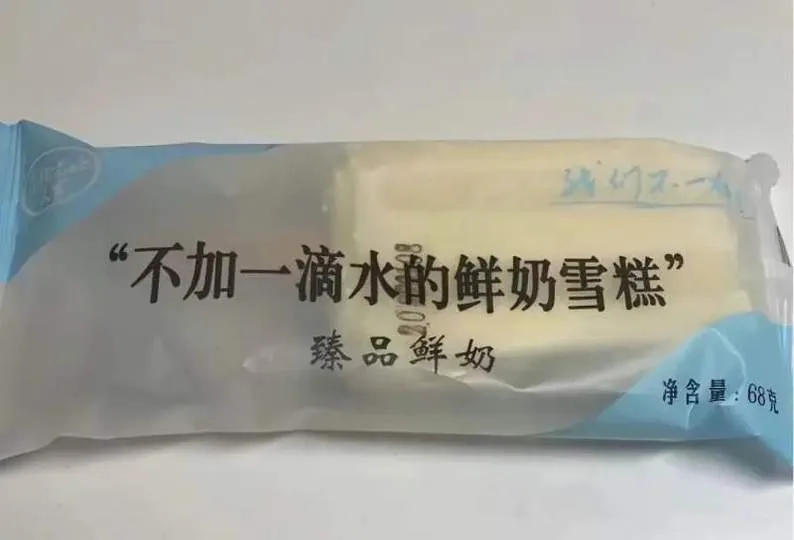
This revelation, which trended on Toutiao (今日头条) with over 3 million engagements, isn't just about one dishonest ice cream brand. It's a perfect microcosm of the trust crisis in China's consumer food market — and the way Chinese internet culture has turned ingredient-label reading into a form of guerrilla warfare against corporate deception.
Let's break down why this hit such a nerve.
The audacity is the art
In China's fiercely competitive frozen treats market — worth an estimated 180+ billion RMB annually — brands have been locked in an arms race of premiumization. The logic is simple: convince consumers your ice cream isn't just frozen sugar water, but a crafted experience. Hence the avalanche of marketing buzzwords: 「纯牛乳」(pure milk), 「零添加」(zero additives), and the reigning champion of deception, 「不加一滴水」.
The claim works because it implies richness. No water means everything creamy, everything substantial, everything that makes ice cream ice cream instead of flavored ice. It's the frozen dessert equivalent of a restaurant claiming they use only fresh-pressed juice when they're pouring from a concentrate bottle.
But here's where Chinese labeling regulations actually do something useful: ingredients must be listed in descending order by weight. So when water appears first on a product literally named after its absence, you're not dealing with a technicality. You're dealing with industrial-scale audacity.
The ingredient-list detectives
Over the past two years, a fascinating subculture has emerged on Douyin (抖音), Xiaohongshu (小红书), and Bilibili (B站): the ingredient-label investigators. These are regular consumers — often with backgrounds in food science, chemistry, or just obsessive attention to detail — who film themselves flipping over product packages and reading the fine print aloud.
They've exposed protein bars with more sugar than protein. They've caught 「whole grain」 snacks that are 80% refined flour. They've demolished the reputation of more than one hyped brand. And their audiences are massive — some of these creators pull millions of views per video, because in a market saturated with exaggerated claims, there's genuine demand for someone willing to simply... read the label.
The 「不加一滴水」ice cream scandal fits perfectly into this genre. It's satisfying because the deception is so legible. You don't need a chemistry degree. You don't need to understand emulsifiers or stabilizers. The claim is "no water." The first ingredient is water. Case closed.
Why ice cream, why now?
China's ice cream market has undergone a bizarre transformation over the past five years. The old guard — cheap, cheerful brands like Mengniu (蒙牛) and Yili (伊利) selling basic red bean and green tea bars for 2-3 RMB — found themselves competing against a wave of premium upstarts charging 15, 20, even 30 RMB for artisanal scoops on a stick. Brands like Chicecream (钟薛高), with their distinctive tile-shaped bars and literary-aesthetic branding, briefly became status symbols — the kind of thing you'd photograph before eating.
But the premium ice cream bubble has been deflating. Consumers tired of paying luxury prices for products that, upon closer inspection, weren't fundamentally different from their cheap counterparts. Chicecream itself faced multiple scandals — from melting resistance (what's in this thing that it won't melt at room temperature?) to flame retardant allegations (overblown, but the damage was done). The entire "high-end ice cream" category took a reputational beating.
This latest scandal is the aftershock. Chinese consumers have been trained by experience to be suspicious, and now they're doing the investigative work themselves — at scale, on social media, with millions of witnesses.
The bigger picture: trust as a luxury good
What makes stories like this resonate isn't just the dishonesty. It's the casualness of the dishonesty. A brand literally printing the opposite of reality on its own packaging and assuming nobody would check — or that checking wouldn't matter — reveals something deeper about how some companies view Chinese consumers.
The assumption seems to be: marketing overrides reality. Perception is the product. And for a long time, that worked. China's rapid consumer expansion meant millions of first-time buyers for whom premium packaging and bold claims were enough. But the internet has a long memory, and social media has given consumers a megaphone.
Toutiao's algorithm amplifying this story to 3 million+ engagements isn't an accident. It's the platform recognizing — correctly — that food fraud outrage is one of the few things that unites virtually all Chinese internet users. Whether you're a tech worker in Shenzhen or a teacher in a tier-3 city, you've been sold something that wasn't what it claimed to be. The shared experience of being lied to by a food brand is practically a national bonding ritual.
What happens next
The brand in question will likely issue one of those classic non-apology apologies — 「we take product quality seriously and will strengthen our communication」 — and quietly rebrand. The ingredient-list detectives will move on to the next target. And somewhere in China right now, a product development team is probably brainstorming a new marketing claim that technically violates no regulations while still being fundamentally misleading.
But the dynamic has shifted. Chinese consumers aren't just reading labels — they're broadcasting what they find. Every package flip is a potential viral moment. Every exaggerated claim is a pending scandal. And in a market where reputation can be destroyed in hours, the calculus of deception is getting harder to justify.
The「不加一滴水」ice cream isn't just a bad product. It's a fossil — a relic of an era when Chinese brands could say whatever they wanted and assume the people buying their products weren't paying attention. They're paying attention now. And they've got smartphones.