China's Homegrown Motorcycles Are Now the Status Symbol Hong Kong Actually Wants
Here's something that would've been laughable five years ago: a Hong Kong motorcycle distributor going on camera to brag about how mainland Chinese bikes are flying off the showroom floor. Yet here we are. The headline blazing across Toutiao (今日头条) with over 5.5 million views — 「张雪机车香港总代理谈国产机车受追捧」 — translates roughly to "Zhang Xue Motorcycles' Hong Kong distributor discusses the craze for domestically-made bikes." And it's not clickbait. It's a genuine cultural flex.
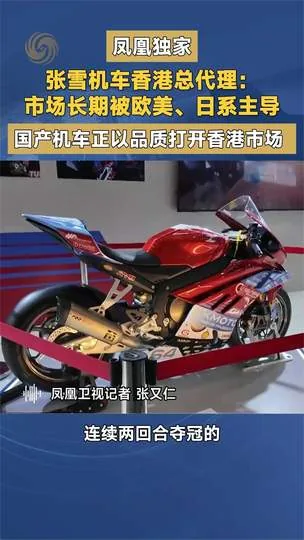
Let's rewind. Zhang Xue (张雪) — the namesake founder behind Zhang Xue Motorcycles — is one of those obsessive Chinese entrepreneurs who built a brand on pure petrolhead energy. The company has been carving out a niche in China's mid-to-high displacement motorcycle market, competing against Japanese stalwarts like Honda, Yamaha, and Kawasaki, plus European prestige names like BMW Motorrad and KTM. For years, "国产机车" (domestically-produced motorcycles) carried a stigma: cheap, unreliable, something you bought because you couldn't afford the real thing. That perception is now colliding with reality, and reality is winning.
The Hong Kong angle is what makes this explosive. Hong Kong isn't just any market — it's a city where Japanese and European motorcycle brands have held unchallenged dominance for decades. If Chinese-made bikes are gaining traction there, it signals a genuine quality shift, not just patriotic buying. The Toutiao headline specifically references the Hong Kong exclusive distributor voluntarily talking up demand. Distributors don't hype products that don't sell. They hype products they can't keep in stock.
So what's driving this? Three forces are converging simultaneously, and they tell us everything about where Chinese consumer culture is heading in 2025.
First: the "domestic products can actually compete" awakening. Across category after category — from Pop Mart (泡泡玛特) collectibles to DeepSeek (深度求索) AI models to Unitree (宇树科技) humanoid robots — Chinese consumers are experiencing a collective reassessment. The old assumption that "foreign = better" is being stress-tested by products that are, genuinely, good. Zhang Xue's bikes aren't winning on price alone (though they're competitive). They're winning on design, engineering, and that intangible desirability factor that turns a vehicle into a lifestyle statement.
Second: motorcycle culture in China has exploded post-pandemic. Young urban professionals — the same demographic fueling the milk-tea wars and Labubu toy hysteria — discovered riding as both escape and identity. Weibo (微博) and Xiaohongshu (小红书) are flooded with aesthetic motorcycle content: scenic rides through Guizhou, vintage-modified bikes in Shanghai alleyways, full-kit influencers posing beside their machines like modern knights. Bilibili (B站) motorcycle vloggers have become mini-celebrities. The Chinese word "机车" (motorcycle) has trended repeatedly this year as a lifestyle keyword, not just a vehicle category. Zhang Xue tapped into this cultural wave early, building bikes that look as good on camera as they perform on the road.
Third: the "国潮" (guócháo — national trend) premium has matured beyond empty patriotism. The first generation of guócháo marketing was just slapping traditional Chinese patterns on mediocre products and calling it cultural confidence. Consumers saw through it. The current generation — exemplified by companies like Zhang Xue — earns the flag-waving after proving the product works. The Hong Kong distributor isn't saying "buy this because it's Chinese." He's saying "people are buying this because it's genuinely desirable, and oh by the way, it happens to be Chinese." That sequencing matters enormously.
The numbers tell part of the story. China's motorcycle exports have been climbing steadily, with mid-to-large displacement bikes (250cc and above) showing the most dramatic growth. But the real signal isn't export volume — it's market perception shift. When mainland Chinese tourists started posting on Douyin (抖音) about spotting Zhang Xue motorcycles in Hong Kong showrooms, the comment sections weren't dismissive. They were proud, curious, and — crucially — knowledgeable. People debated specs, compared torque curves, discussed suspension setups. This isn't blind nationalism. This is an informed consumer base recognizing their domestic industry has leveled up.
The broader pattern here connects directly to what we track at Qipao Buzz across AI, robotics, and consumer tech. Whether it's DeepSeek matching GPT-4 performance at a fraction of the cost, or Fourier (傅利叶) shipping humanoid robots that actually walk reliably, or Zhang Xue building motorcycles that Hong Kong riders voluntarily choose over Honda — the underlying story is the same. China's manufacturing and engineering ecosystem has moved from "competent at copying" to "capable of innovating" across an astonishing range of sectors simultaneously.
What makes the motorcycle story particularly resonant is its tactile, emotional nature. AI models are abstract. Robots are impressive but distant. But a motorcycle? That's steel and chrome and exhaust notes and the physical sensation of leaning into a curve at speed. When Chinese consumers feel pride about a domestic motorcycle, they're feeling something more visceral than patriotic satisfaction — they're feeling genuine excitement about something they can ride, touch, and be seen on.
The Zhang Xue Hong Kong moment also reveals something about how Chinese internet culture processes quality validation. The Toutiao trending status wasn't driven by the company's own marketing — it was amplified by users sharing the distributor's comments as evidence of a larger shift. The story spread because it confirmed something people wanted to believe but needed proof for. Hong Kong, with its reputation as a discriminating international market, serves as that proof. It's the same reason Chinese AI benchmarks gain credibility when Western researchers replicate them, or why Chinese robot videos go viral only after unedited factory demonstrations.
For global observers, the takeaway is straightforward: stop assuming "Chinese-made" is a value judgment and start treating it as a neutral descriptor. The motorcycles are just the latest example. They won't be the last.