1,000 Strangers Obliterated 16 Acres of Garlic Scapes in 48 Hours
Here's the scene: A farmer in central China puts out a call — free garlic scapes (蒜薹, suàntái), come and get 'em. Within 48 hours, nearly 1,000 people swarm 100 mu (百亩, roughly 16.5 acres) of farmland and strip every single stalk bare. The Toutiao (今日头条) headline roared to a scorching hot score of 13.4 million. China's feed is obsessed.
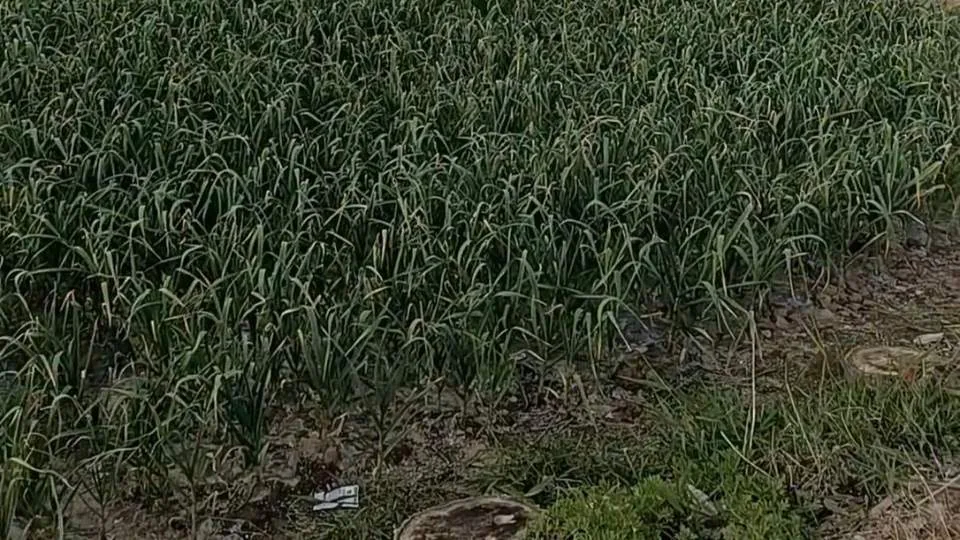
Let's be clear about what happened here. This wasn't a coordinated agricultural operation. This wasn't a corporate supply chain optimization play by Pinduoduo (拼多多) or Meituan (美团). This was pure, uncut, decentralized human swarm behavior — amplified by short video and group chats until a critical mass of bodies materialized in a field somewhere in China's heartland.
Garlic scapes — those curly green stalks that shoot up from garlic bulbs before harvest — are a seasonal delicacy in China. They appear briefly in spring, get stir-fried with pork or pickled, and then vanish. Farmers need to remove them anyway so the garlic bulbs underground can grow fat. It's tedious, labor-intensive work. The calculation here was brutally simple: let the internet do the harvesting for free.
And the internet delivered. Oh, did it deliver.
A thousand people. Two days. Sixteen acres. Gone.
This is the same mobilization logic that powers flash mobs, Black Friday door-busters, and those legendary Japanese train-station commuter surges — except it's agricultural labor being crowdsourced through Douyin (抖音) videos and WeChat (微信) neighborhood groups. Someone probably posted a 15-second clip of themselves yanking garlic scapes out of the ground with the caption "FREE VEGETABLES" and the algorithm did what the algorithm does: it found every person within driving distance who owns a reusable shopping bag and a dream.
What makes this story vibrate at 13 million hot-score intensity isn't the garlic. It's what the garlic represents. China is deep in a cultural moment where "county-tier" (县域) experiences carry enormous social currency. Urban professionals in Zhengzhou or Wuhan aren't just scrolling past this — they're loading up the family sedan and driving 45 minutes to a field so their kid can experience "real" agricultural labor for the first time. It's agritourism stripped to its most primal form. No ticket price. No curated experience. Just mud, vegetables, and the primal satisfaction of pulling something out of the ground that you will later eat.
There's also a potent economic undercurrent. Grocery prices in Chinese cities have been a simmering anxiety point. When someone offers free produce — good, fresh, seasonal produce — the response is visceral. These aren't people who are starving. These are people whose monthly food budget has crept up quietly over the past two years while their salaries haven't. A free bag of garlic scapes isn't going to fix anyone's household economics, but it feels like winning. It feels like outsmarting the system.
The Douyin content pipeline around these events is a marvel of emergent media infrastructure. Within hours, you get the aerial drone shots of the crowd spreading across the field like locusts. You get the first-person GoPro footage of someone's grandma filling a sack with terrifying efficiency. You get the philosophical reflections from twenty-somethings who "never knew where garlic scapes came from." You get the inevitable follow-up recipe videos — five ways to cook your free garlic scapes — posted by food influencers riding the algorithm wave.
And then you get the debate. Oh, the debate. Comment sections on Toutiao and Weibo (微博) exploded with the same argument that always surfaces when free things happen in China: Is this beautiful community solidarity or is this shameful mob behavior? Are these people helping a farmer or are they parasites exploiting agricultural generosity? Someone always posts the security-camera footage of one person filling eight bags while their friend double-parks a BMW at the field's edge. Someone else posts a tearful thank-you video from the farmer, who seems genuinely shocked that their call for help turned into a small-scale agricultural apocalypse.
The truth, as always, is somewhere in the muddy middle. The farmer got his field cleared for free — labor that would have cost thousands of RMB and taken weeks. The visitors got fresh produce and a story to post on Xiaohongshu (小红书). The platforms got engagement metrics that would make any content strategist weep with envy. Everyone, in their own way, won.
But what lingers is the image itself: a thousand people, bent over in a field, united by nothing more than the promise of free garlic scapes and the viral momentum of a video that told them to come. In a China increasingly defined by AI model releases from DeepSeek (深度求索) and humanoid robot demos from Unitree (宇树科技), there's something deeply human about a story where the headline innovation is just... a lot of people showing up to pull vegetables out of the ground.
No algorithms harvested that field. No robots. No drone fleet. Just a thousand humans with two legs, two arms, and the ancient knowledge that free food is worth driving for.
Some things, it turns out, don't need disrupting.