Is the US Stock Crash AI's First Real Hit on the Global Economy?
The US stock market took a beating, and Chinese internet has a theory: this is AI's first real economic gut-punch to humanity.
The headline "美股暴跌是AI第一次冲击人类经济吗" — trending near the top with nearly 3 million heat points on Toutiao (今日头条) — captures a distinctly Chinese reading of global market chaos. While Western financial press scrambles to explain plunging tech stocks through traditional lenses (inflation! rates! earnings misses!), Chinese netizens are cutting straight to the existential question: What if this is the moment AI stops being a parlor trick and starts restructuring the actual economy?
It's a headline that tells you two things. First, that Chinese internet users are paying close attention to US markets — the fortunes of Wall Street are still treated as a barometer of global tech health, even amid decoupling noise. Second, and more interestingly, it reveals a genuine anxiety-cum-fascination with AI as an economic force that's now too big to ignore.
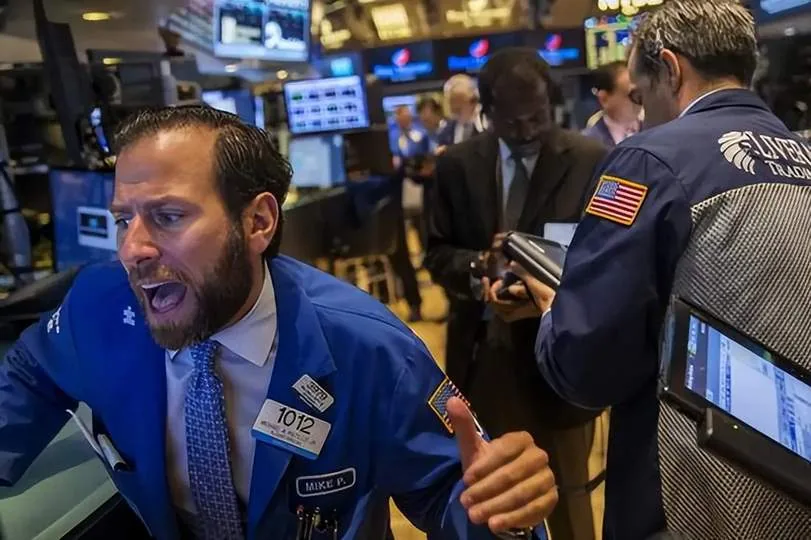
The timing matters. This headline surfaces amid a brutal stretch for US equities, particularly tech stocks that have been bid up on AI hype. The Nasdaq has been volatile, the "Magnificent Seven" have looked less magnificent by the week, and the AI bubble narrative — long dismissed as premature — is suddenly being taken seriously by people who matter.
But here's where the Chinese angle gets spicy: the country asking "is this AI's first economic shock?" is the same country that may have helped trigger it.
Remember January 2025? When DeepSeek (深度求索) dropped and wiped roughly a trillion dollars off US tech valuations in a single day? That wasn't just a model launch — it was an economic event. A Chinese AI lab, working with a fraction of the compute budget, released an open-weights model that punched holes in the narrative that AI supremacy required Silicon Valley budgets and NVIDIA's entire quarterly output. The hangover from that moment hasn't really ended.
Chinese tech circles now treat that episode as a turning point — not just technically, but economically. The implicit message of this Toutiao headline is: We already saw what a Chinese AI breakthrough did to US markets. Now we're watching the aftershocks play out in real time.
The commentary threads beneath this headline split into a few recognizable camps.
The techno-triumphalists argue that AI is finally doing what it promised — disrupting, reallocating capital, destroying inefficient business models. If stocks crash, that's just the market pricing in real transformation. The wrenching is the point.
The bubble-skeptics counter that this has nothing to do with genuine AI economic impact and everything to do with speculative excess finally unwinding. You can't call a valuation correction "AI's first economic shock" when the "AI" in question is mostly stock-promotion and conference-stage demos.
The anxiously curious — the largest group — just want to know: if AI is now moving trillion-dollar markets, what happens next? When does "economic impact" graduate from stock volatility to actual labor displacement, industry restructuring, and productivity gains you can feel?
What's genuinely fascinating is how this conversation has become explicitly global on the Chinese internet. Five years ago, a US stock crash would have been discussed in China primarily through the lens of "how does this affect us?" — trade exposure, supply chains, yuan stability, export orders. Today, the framing is different: Chinese netizens are discussing US market turmoil as a shared AI-driven phenomenon. The implicit assumption is that AI has created a single, interconnected economic story — and China is co-author.
This matters because it reflects a shift in Chinese tech self-perception. The country no longer sees itself as merely a follower or competitor in AI — it sees itself as a co-equal shaper of the global AI economic reality.
The Chinese AI labs know this, and they're positioning accordingly. Alibaba's Qwen (通义千问) continues its relentless open-weights release schedule. ByteDance's (字节跳动) Doubao (豆包) is pushing consumer AI adoption at staggering scale. Moonshot's Kimi (月之暗面), Zhipu's GLM series (智谱清言), MiniMax, Baichuan (百川), and 01.AI's (零一万物) Yi models — they're all part of an ecosystem that increasingly believes the global AI story cannot be told without China, and vice versa.
Here's my take: the Toutiao headline is asking the right question, even if the timing is debatable.
AI has been impacting the economy for years — just quietly. It's been optimizing ad delivery, powering recommendation engines on Douyin (抖音) and Xiaohongshu (小红书), automating customer service, and quietly restructuring work since well before ChatGPT made it a dinner-table topic. What's new is that the economic effects are now loud enough for headline-writers to notice.
When a model launch can move markets, when an open-weights release can destabilize a valuation thesis, when a Chinese lab's cost-efficiency claims can trigger a selloff — that's AI economics graduating from theory to front-page news.
The Chinese internet gets this intuitively. China has lived through platform-economy disruptions that destroyed and created entire industries within a decade — the e-commerce wars between Pinduoduo (拼多多), Alibaba, and JD.com; the livestream-commerce revolution; the rise and recalibration of Meituan (美团) in food delivery and local services. The idea that a technology can restructure an economy overnight isn't abstract for Chinese consumers — it's lived experience, sometimes painfully so.
So when a Toutiao headline asks whether the US stock crash is "AI's first economic shock to humanity," what it's really asking is: Is this the moment the rest of the world finally catches up to what China already knows — that AI isn't just a tool, it's an economic force that doesn't ask permission before reorganizing your portfolio?
Whether the answer is yes or no, the question itself tells you where the Chinese conversation has moved. And spoiler: it's already past "will AI matter?" and deep into "how fast can we build the next thing that matters?"
The US market will recover, as markets do. But the framing — AI as economic protagonist — is here to stay. And it's being shaped as much from Beijing, Hangzhou, and Shenzhen as from San Francisco and New York.
The Chinese internet isn't just watching the crash. It's already writing the next chapter.