China's Stock Market Is Going Full Tech
The hottest headline on Toutiao (今日头条) right now isn't about a celebrity scandal or a milk-tea collab. It's five characters that would put any Western retail investor to sleep: A股"含科量"飙升 — "A-shares' 'tech content' is soaring."
Translation for those who don't speak broker: the proportion of science-and-technology companies in China's mainland stock market is skyrocketing. And behind that snoozy phrase is one of the most important structural shifts happening in Chinese capitalism right now.
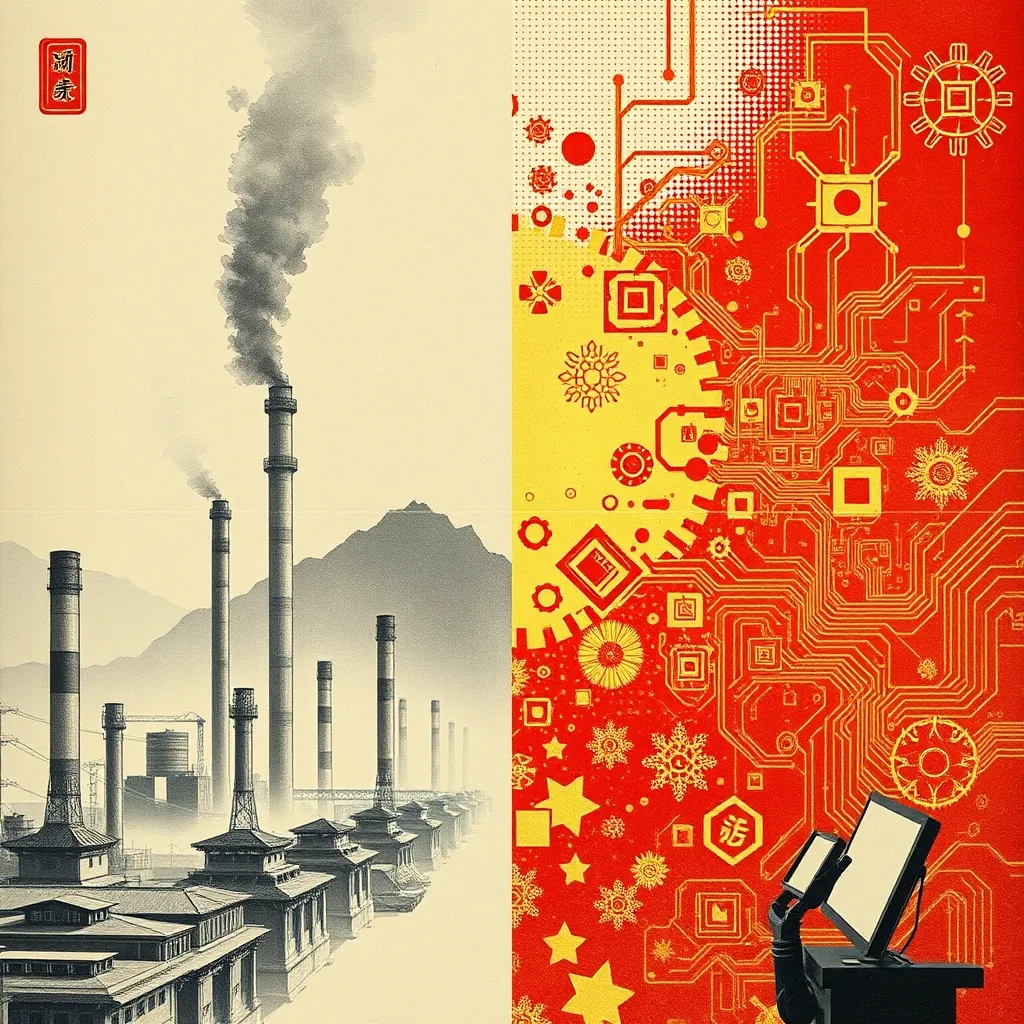
Here's the deal. For decades, the A-share market (A股, China's mainland-listed stocks denominated in renminbi) was a graveyard for steel mills, coal producers, state-owned banks, and real estate developers. If you wanted to bet on "China Inc.," you were basically betting on cement. The tech content — 含科量, literally "how much science it contains" — was embarrassingly low. Western investors joked that the Shanghai Composite was a leveraged play on property and ghost cities.
That's changing violently.
Over the past two years, STAR Market (科创板, the Nasdaq-style board launched in 2019 for sci-tech firms) has minted IPOs at a furious pace. The composition of major indices has shifted hard toward semiconductors, AI, biotech, new energy materials, and robotics. We're talking about companies designing chips on Huawei's (华为) Ascend architecture, AI labs racing to match GPT-4, humanoid-robot makers like Unitree (宇树科技) whose H1 bot went viral dancing with the whole internet watching, and Fourier (傅利叶智能) pushing the GR-1 into commercial pilots.
The market is finally reflecting what's actually happening on the ground in Shenzhen and Hangzhou and Beijing: China is pivoting from "world's factory" to "world's lab." And the stock market — long a laggard indicator — is catching up to the vibe.
Why does this matter for the internet-culture crowd? Because retail investors in China are not like retail investors in America. They're not buying index funds and forgetting about it. They're on Toutiao, on Douyin (抖音), on Weibo (微博), arguing about semiconductors and large language models the way American finance bros argue about crypto. When DeepSeek (深度求索) drops a new model, or when Zhipu (智谱) launches GLM-4, or when Alibaba's (阿里巴巴) Qwen/Tongyi (通义千问) tops an open-source leaderboard, it doesn't just make the AI Twitter rounds — it moves actual retail money.
The 含科量 conversation is, at its core, a culture war about what China's economy should be. On one side: the old guard of property developers, liquor stocks (Kweichow Moutai / 贵州茅台 is still a market deity), and infrastructure plays. On the other: a generation of investors who grew up watching Douyin livestreams of Unitree robots doing backflips, who use Kimi (月之暗面) to write their essays, who buy Pop Mart (泡泡玛特) Labubu figures on Pinduoduo (拼多多), and who genuinely believe the next decade belongs to whoever owns the AI stack.
The fact that "含科量" is trending with nearly 24 million heat on Toutiao's hot board tells you this isn't just a story for securities analysts. It's a story about national mood.
And the numbers back the hype. STAR Market listings have raised hundreds of billions of yuan since launch. Semiconductor companies now make up a meaningful double-digit percentage of the board. AI-related stocks routinely move 10-20% on a single model launch or benchmark result. When a robotics company announces a new humanoid — whether it's Agibot (智元), UBTech (优必选), or XPeng's (小鹏) IRON — the stock-reaction algorithm kicks in before the press release is even finished loading.
Here's my opinionated take: this shift is real, it's overdue, and it's going to get messier before it gets cleaner.
The good: China's best companies are finally accessible to Chinese retail investors at early stages, not just through offshore vehicles or after Wall Street has already extracted its pound of flesh. The STAR Market's registration-based IPO system means faster listings, more capital for founders, and a tighter feedback loop between innovation and markets.
The ugly: retail investors chasing "tech" will chase anything with a fancy prospectus. Expect scams, pumps, and companies whose "AI" is a chatbot wrapper. Expect volatility that makes meme stocks look tame. When 含科量 becomes a marketing term rather than a measurable metric, you get bubble logic.
But make no mistake — the direction is correct. A stock market weighted toward foundries and property developers cannot price the future. A market weighted toward AI labs, chip designers, robotics startups, and consumer-internet platforms actually can.
China's A-shares are finally getting a tech transplant. Whether the patient thrives or rejects the organ is the next decade's most interesting financial story.
For the global audience watching from the outside: stop treating Chinese markets as a black box of state-owned enterprises. The 含科量 is rising, the retail army is plugged in, and the companies driving it are the same ones going viral on Douyin every single day. The stock market and the feed are converging — and that's a story worth paying attention to.