China's Holiday Travel Apocalypse: Mountains, Seas, Bridges, Roads — ALL BLOCKED
If you want to understand China in one image, forget the gleaming skyscrapers and AI labs. Picture this: 1.4 billion people all deciding to go somewhere — at the exact same time. The trending headline on Toutiao (今日头条) right now says it all with bone-dry perfection: 「堵山、堵海、堵桥、堵路」 — "Blocked mountains, blocked seas, blocked bridges, blocked roads." With a scorching heat score of 16.7 million, this four-phrase horror story has resonated with essentially every Chinese person currently trapped in a vehicle somewhere, asking themselves why they didn't just stay home and scroll Douyin (抖音).
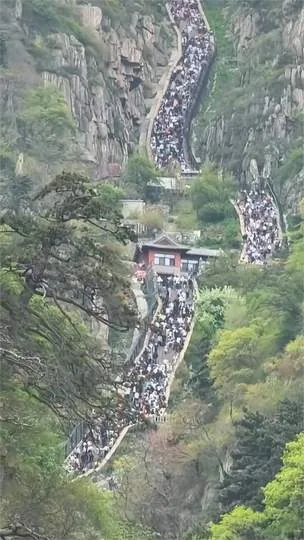
Let me translate the apocalypse for you: during China's major holiday travel rushes — whether Golden Week, Spring Festival, or the recent Qingming/Tomb-Sweeping sweep — the entire country transforms into the world's largest parking lot. Mountains? Gridlocked. Coastal highways? Stationary. Every bridge worth crossing? Better walk. Regular roads? Forget it. The phrase has become a dark, collective mantra of resigned acceptance.
Here's why this matters beyond simple schadenfreude: China's holiday travel phenomenon, known as 「春运」 (chūnyùn) for Spring Festival or broadly as 「黄金周」 (Golden Week) chaos, represents the largest annual human migration on Earth. We're talking about 3 billion passenger trips during the Spring Festival period alone. That's not a typo. The infrastructure strain is biblical.
The brilliant economy of the headline is its structural parallelism — each phrase follows the same rhythm, building like a grim poem. 堵山 (dǔ shān): mountains blocked. 堵海 (dǔ hǎi): seas blocked. 堵桥 (dǔ qiáo): bridges blocked. 堵路 (dǔ lù): roads blocked. Four characters each, four different terrain types, one universal experience of complete immobility. It's the kind of thing that gets meme'd into oblivion on Weibo (微博) within hours.
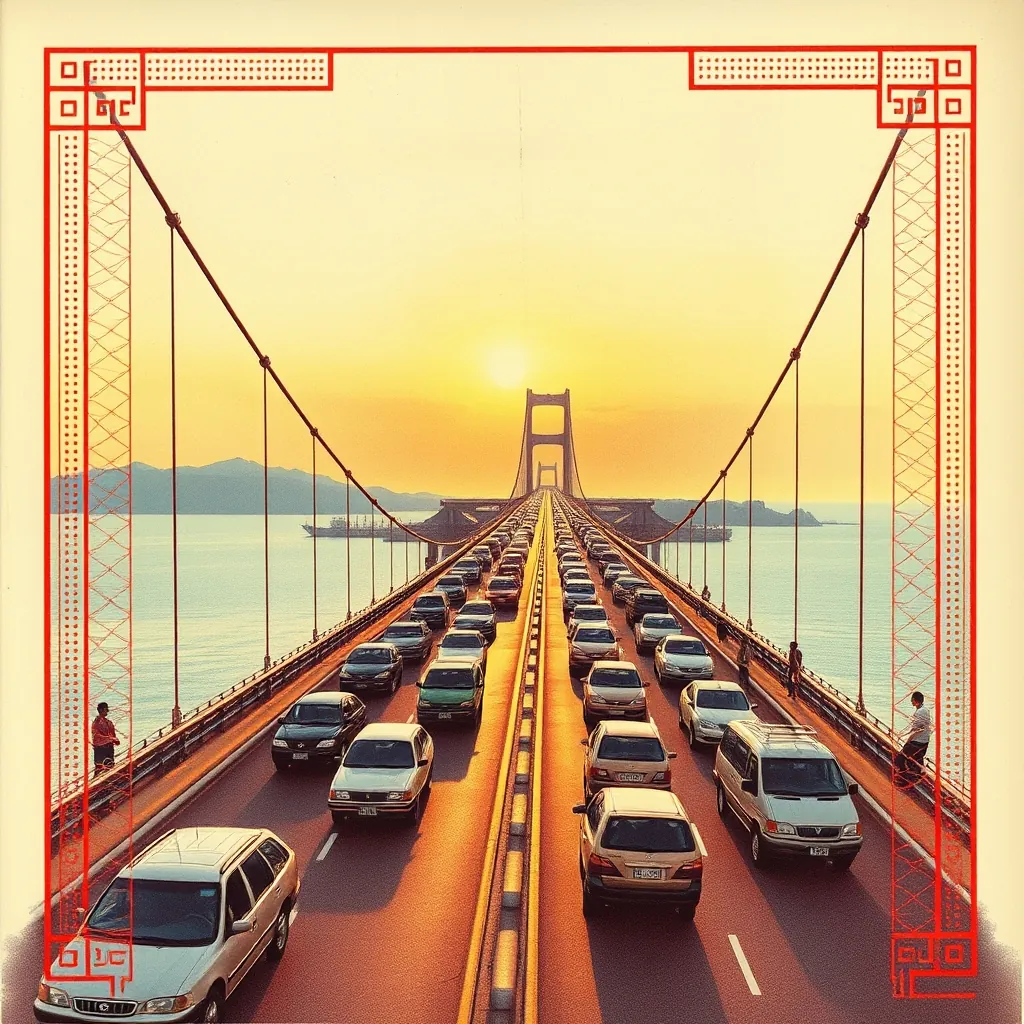
What's actually revealing here is the psychology. Chinese travelers know this will happen. Every. Single. Year. Yet millions still pile into cars and onto trains, driven by filial piety, FOMO, or the desperate need to use those precious paid vacation days that only exist during state-mandated holiday windows. China's vacation system effectively forces everyone into the same travel windows, creating demand spikes that no infrastructure could handle.
The Toutiao comments section is pure anthropological gold. Top-voted reactions include travel survival tips that sound like military strategy, people sharing their 「堵车」 (traffic jam) selfies where they've gotten out of cars to stretch, do tai chi, or — in legendary past instances — play cards, cook hotpot on the median, or go fishing in nearby ponds. One woman reportedly gave birth in a car during Spring Festival traffic. The resilience and dark humor would make stoic philosophers weep.
The numbers behind the nightmare: China's highway network now exceeds 177,000 km of expressways alone — the world's longest. High-speed rail connects virtually every major city with trains hitting 350 km/h. The country has poured trillions of yuan into infrastructure. And it's still not enough. Because when 800 million people decide to travel in a two-week window, physics itself becomes the bottleneck.
On Xiaohongshu (小红书), the holiday travel content is a genre unto itself: aesthetic 「避堵攻略」 (traffic-avoidance guides) that inevitably fail, scenic photos of destinations with the caption 「worth the 12-hour drive」 (spoiler: the comments disagree), and real-time traffic reports that are essentially live doomscrolling. The platform's travel influencers have turned traffic jam content into engagement gold.
Here's my take: this annual chaos is actually a testament to China's rising middle class and their growing demand for leisure. You can't have gridlock without car ownership, and China went from virtually no private cars to over 300 million in three decades. The traffic jams are, perversely, a sign of prosperity and mobility that previous generations could never imagine.
But it also reveals the deep structural problem with China's holiday system. Workers get limited flexible time off, so everyone is funneled into the same windows. It's centralized vacation planning at scale, and the result is predictable pandemonium. Until workplace culture shifts toward more flexible personal leave, no amount of new highway lanes will solve this.
Meanwhile, on Bilibili (B站), you'll find compilations of the most unhinged traffic jam moments: grandmas leading group exercises on the highway, families setting up full picnic spreads on the shoulder, and drone footage showing expressways transforming into 50-kilometer linear parking lots. It's performance art meets infrastructure failure meets community bonding.
The tech angle? Navigation apps like Gaode (高德地图) and Baidu Maps (百度地图) essentially crash under the weight of routing requests. AI can't solve for the fact that everyone wants to be somewhere else simultaneously. Even DeepSeek (深度求索) couldn't optimize this — there's simply no mathematical solution when demand exceeds physical capacity by 10x.
The meme-ification of 「堵山、堵海、堵桥、堵路」 also speaks to a uniquely Chinese form of collective coping. When suffering is universal, it becomes comedy. The shared trauma of holiday travel binds the nation in a way no propaganda campaign could — through mutual exasperation and the knowledge that your traffic jam suffering is being replicated by hundreds of millions of your compatriots.
So if you're watching from abroad, wondering what China feels like right now, don't look at the GDP numbers or the AI benchmark wars. Look at 16.7 million people hearting a headline that says "everything is blocked." That's the real China — massive, mobile, frustrated, and somehow still moving forward, one traffic jam at a time.