China's Mountains Are Getting Elevators Now and Everyone's Furious
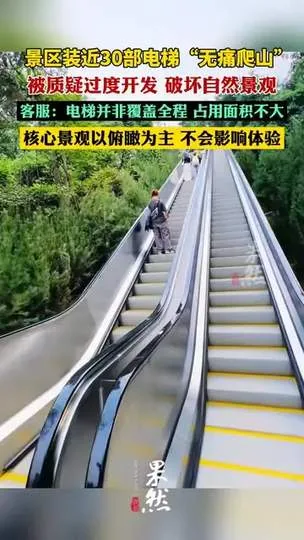
Thirty elevators. In a mountain. A scenic mountain.
A Chinese tourist attraction — yet unnamed in the viral Toutiao (今日头条) post that's racked up over 3.3 million views — decided the best way to "improve visitor experience" was to bolt three dozen elevator shafts into pristine landscape, and the Chinese internet is having none of it.
The headline 「景区装30部电梯被质疑过度开发」 ("Scenic area installs 30 elevators, questioned for over-development") has become a Rorschach test for how regular Chinese people feel about the relentless commodification of literally everything beautiful in the country.
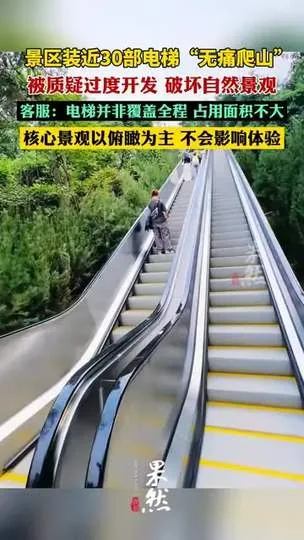
Here's the thing: this isn't new. Chinese scenic areas have been in an arms race of "accessibility infrastructure" for over a decade. Remember when Zhangjiajie (张家界) built a glass-bottomed bridge and it immediately became the most photographed structure in China? Or when dozens of scenic spots installed glass walkways and they became so ubiquitous that Douyin (抖音) essentially ran a years-long "who can pretend to be more terrified" challenge?
But elevators hit different. Elevators say: "You know what? Walking is for peasants. Nature should come to YOU."
The reaction on Chinese social media has been swift and savage. The top-voted comments on Toutiao range from bitter sarcasm ("Why not just install escalators to the summit?") to genuine mourning for what's being lost. One commenter wrote: "Soon they'll put a roof on the mountain so you don't get rained on." Another: "Just pave the whole thing and turn it into a mall already."
What's actually happening here is a collision between two powerful forces in Chinese consumer culture.
Force #1: The "Silver Economy" Accessibility Mandate
China's population is aging rapidly. By 2035, an estimated 400 million Chinese citizens will be over 60. Scenic areas are under real pressure from local governments to make attractions accessible to elderly tourists who have the time and disposable income but not the knee cartilage. An elevator isn't just a convenience — it's a revenue pipeline from the fastest-growing demographic in Chinese tourism.
Some commenters acknowledged this tension: "My 75-year-old mother can't climb mountains anymore but she wants to see the views. Who are we to deny her?" This take got traction, but it was drowned out by...
Force #2: The Aesthetic Purist Backlash
A younger, more affluent, social-media-native generation of Chinese travelers has developed a fierce appetite for "authentic" experiences. These are the people filling Xiaohongshu (小红书) with "hidden gem" guides to undeveloped villages and writing earnest reviews about how commercialization "ruins the vibe." They've watched countless scenic areas transform from natural wonders into glorified shopping malls with ticket booths, and they're exhausted.
This cohort also remembers the shockingly fast construction of China's tourism infrastructure boom (2010-2019), when local governments desperate for GDP growth greenlit every tacky "cultural village" and glass walkway project that crossed their desks. The trauma of seeing yet another natural wonder turned into a theme park is real.
The Numbers Tell the Story
China's domestic tourism market is enormous — over 6 billion trips annually pre-pandemic, with numbers recovering aggressively. But average spending per trip has been declining as consumers grow savvy about overpriced attractions. The model of "build flashy infrastructure → charge ¥200+门票 (entrance fees) → sell overpriced instant noodles at the summit" is showing cracks.
Meanwhile, county-tier (县域) tourism has exploded, precisely because it offers the "unspoiled" experience that heavily developed scenic areas no longer can. When people on Bilibili (B站) make travel vlogs titled "I went to a place with ZERO commercialization," the algorithm rewards them. The market is literally screaming for less development, not more.
My Take: The Elevator Is a Symptom, Not the Disease
The real scandal isn't thirty elevators in a mountain. It's the incentive structure that makes thirty elevators seem like a rational investment. Local officials need tourism revenue. Tourism bureaus need "modernization" projects to justify budgets. Construction companies need contracts. The loop feeds itself.
Meanwhile, on Pinduoduo (拼多多), you can buy a folding hiking pole for ¥29.9. On Meituan (美团), you can book a local guide who knows the paths that don't need elevators. The tools for a different kind of tourism experience exist. The problem is that nobody with a procurement budget gets promoted for "leaving things alone."
China has some of the most stunning natural landscapes on Earth. It also has some of the most aggressive infrastructure developers. These two facts are increasingly incompatible, and the Toutiao comment section knows it.
The day someone builds an elevator to the top of Huangshan (黄山), I'm booking a flight to another country. Some mountains should make you work for the view. That's literally the point.