Drones Can't Carry People. China Says Watch Me.
A Toutiao (今日头条) headline is detonating across the Chinese internet right now with over 4.2 million heat score, and it's not about some geopolitical standoff or stock market collapse. It's about a drone carrying a person. Sort of.
The headline reads: 「原则上无人机不许吊人但人民大于原则」— "In principle, drones aren't allowed to carry people, but the people are greater than principles."
That's not just a headline. That's an entire philosophy of Chinese innovation, governance, and regulatory pragmatism compressed into sixteen characters.
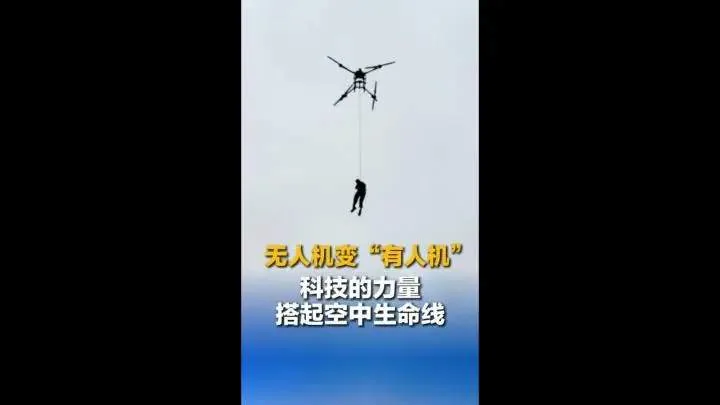
Here's the context: videos have been circulating on Douyin (抖音) and other platforms showing civilian drones — the kind made by Shenzhen's DJI (大疆), the global drone hegemon that controls roughly 70% of the worldwide consumer drone market — being used to lift, carry, or otherwise transport human beings in various creative and questionable configurations. We're talking about agricultural drones meant for crop-spraying being repurposed as ad-hoc personal transit. We're talking about delivery drones being tested with human cargo. We're talking about that uniquely Chinese strain of hardware hacking where if a machine exists, someone will try to ride it.
The regulatory response is technically clear: no, you cannot use civilian drones to carry people. That's dangerous. That's illegal. That violates airspace safety regulations. Full stop.
But the viral headline captures something that every person who has spent time in China immediately recognizes — the gap between the rule on paper and the reality on the ground. "In principle" (原则上) is perhaps the most flexible phrase in the entire Chinese administrative vocabulary. It means "yes, technically, but also no, practically, and definitely maybe." It's the linguistic escape hatch that allows bureaucratic systems to maintain face while ordinary people do what ordinary people do: innovate, experiment, and occasionally strap themselves to spinning rotors.
The second half — "the people are greater than principles" (人民大于原则) — is the punchline that turned this from a regulatory footnote into a viral sensation. It's simultaneously a joke, a political statement, and a genuinely held cultural value. The Chinese internet loves this tension. On Weibo (微博), commenters are split between celebrating the ingenuity, worrying about safety, and memeing the phrase into oblivion. "The people are greater than principles" is being repurposed for everything from jaywalking justifications to workplace grievances to marriage advice.
But beneath the memes, there's a real story about Chinese hardware culture that global observers should pay attention to.
DJI, founded by Frank Wang (汪滔) in 2006 out of a Hong Kong University of Science and Technology dorm room, didn't become the world's dominant drone manufacturer by following principles. It became dominant by iterating faster than regulators could regulate. The Mavic series, the Mini series, the Agras agricultural drones — each generation pushed against the boundaries of what civilian drones were "supposed" to do. When Western regulators fretted, Chinese engineers shipped.
This drone-carrying-people moment is part of a broader pattern visible across Chinese technology culture right now. It's the same energy driving Unitree (宇树科技) to make humanoid robots that can walk, run, and ride bikes. It's the same impulse behind the viral videos of Fourier (傅利叶) GR-1 humanoids serving tea. It's the same philosophy that turned Pop Mart (泡泡玛特) from a niche collectible company into a global lifestyle brand valued at over HK$200 billion. The principle says X. The people want Y. Watch what happens.
The agricultural drone angle is particularly revealing. China's rural areas have adopted drone technology at a pace that would shock most Western observers. DJI's Agras series alone has deployed thousands of units across Chinese farmland, and farmers — not exactly the demographic Western marketers picture when they think "early adopters" — have become some of the most creative drone hackers on the planet. When you've got a machine that can lift 40 kilograms of pesticide and fly autonomously across terraced hillsides, the leap to "what if it lifted Uncle Wang instead" isn't that far.
The safety concerns are legitimate. Civilian drones are not designed for human transport. Rotor failure means catastrophic injury. Battery failure means falling from significant height. Regulatory frameworks exist for reasons that aren't just bureaucratic buzzkill. The Toutiao commenters calling this reckless aren't wrong.
But here's my take: this viral moment isn't really about drones. It's about a society that has learned, through decades of breakneck development, that the gap between "can't" and "did anyway" is where the interesting things happen. China didn't become the world's manufacturing powerhouse, AI laboratory, and consumer-tech incubator by waiting for permission slips. The drone-carrying-person headline resonates because it names something true about how innovation actually works in this country — messily, dangerously, and always with a wink at the rulebook.
The phrase "人民大于原则" will probably fade from the trending lists within days. But the instinct it captures — that human creativity and need will always outrun the regulations designed to contain them — isn't going anywhere. It's the operating system underlying everything from DeepSeek's (深度求索) shockingly efficient AI models to the viral Labubu (拉布布) toy mania that has Chinese millennials spending their salaries on fuzzy monster figurines.
In principle, you shouldn't strap yourself to a crop-spraying drone. In practice, someone already did, and 4.2 million people clicked to watch.