Elon Musk Says China Will Dominate AI. He's Not Wrong.
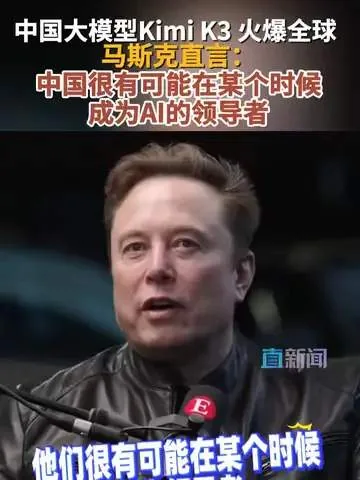
Elon Musk (马斯克) just told the mainland Chinese internet exactly what it wanted to hear, and the Toutiao (今日头条) hot board is currently inhaling it like a vacuum. The headline—boasting a scorching heat index of over 3.6 million—declares: "Musk: China is very likely to become the AI leader."
Usually, when Western tech billionaires blow smoke about China's tech dominance, it is either to justify their own exorbitant R&D budgets to shareholders or to gently scold Washington into subsidizing them more. But Musk isn't just pandering to the domestic algorithm here. If you peel back the layers of the Chinese AI ecosystem right now, you'll see he's not reading a science fiction script. He's reading the room.
Silicon Valley has spent the last year obsessing over existential AI risk, boardroom coups at OpenAI, and $2,000 monthly enterprise subscriptions. Meanwhile, the mainland Chinese tech scene has weaponized the concept of "involution" (内卷 - neijuan, or hyper-competition) and applied it to artificial intelligence. The result? An absolute bloodbath of open-source models, price wars, and consumer adoption that the West simply doesn't comprehend.
Forget the narrative of China endlessly playing catch-up. The actual story trending on the Chinese feed is that domestic labs are currently eating the world's lunch on efficiency and deployment. DeepSeek (深度求索), the AI arm of High-Flyer Capital, dropped a massive bomb on the global open-source community earlier this year. Their DeepSeek-V2 model didn't just match Western benchmarks; it completely shattered the pricing structure of the industry, sending the API costs of large language models into a race to the absolute bottom. By weaponizing algorithmic efficiency, DeepSeek proved that you don't need a trillion dollars in compute to play at the highest level.
This aggressive pricing strategy triggered a brutal price war that has completely consumed the Chinese consumer internet giants. Alibaba (阿里巴巴) fired back by making its Qwen / Tongyi (通义千问) models effectively free for developers and slashing enterprise API costs by a staggering 97%. ByteDance (字节跳动), the titans behind the TikTok empire, aggressively pushed their Doubao (豆包) model, practically giving away tokens to ensure their AI is embedded in every corner of the Chinese digital lifestyle. They aren't treating AI as a premium, luxury tool; they are treating it as a basic utility, like tap water.
This aggressive commoditization is why Musk is actually right. When tech becomes a utility in China, the sheer scale of consumer adoption breaks world records. Look at Moonshot AI (月之暗面) and its wildly popular Kimi (Kimi) chatbot. Instead of capping out at standard context windows, Kimi went straight for a jaw-dropping 2-million-token context length. You can upload a hundred financial reports, a full-length novel, or an entire codebase, and Kimi will analyze it instantly. Chinese consumers didn't just use it to write emails; they used it to build custom super-tools, crashing the servers with sheer demand.
And it's not just software. Musk's real obsession—and the true battlefield for supremacy—is embodied AI. China's humanoid robotics scene is currently exploding. Unitree (宇树科技) is selling the H1 and G1 humanoid robots for the price of a cheap used car, democratizing hardware that Western firms treat like guarded military secrets. Fourier (傅利叶) is pushing the limits of their GR-1 clinical and industrial androids. Meanwhile, startups like Agibot (智元) are pushing out commercial-grade robots designed to work in factories right now. These companies are aggressively bridging the gap between large language model "brains" and cheap, highly capable electromechanical bodies.
The American tech press remains bizarrely fixated on closed-loop consumer apps and the next iPhone killer. But if you look at the actual landscape of Chinese hardware and software, the AI integration is overwhelmingly total. Bilibili (B站) is utilizing AI to generate interactive game NPCs and streamline complex video editing tools for its creators. Xiaohongshu / RED (小红书), the country's premier lifestyle and shopping bible, has its search and discovery algorithms powered by sophisticated machine learning models that read consumer trends before the users even realize they are trending.
When Musk points to China as the likely leader, he isn't just flattering Beijing. He's acknowledging a very real structural advantage: unrelenting, suffocating speed. In Silicon Valley, a startup spends two years in stealth mode, raises a massive Series B, and finally launches an app with heavy PR. In the Chinese ecosystem, a lab open-sources a frontier model on a Tuesday, three consumer apps launch wrappers by Thursday, and by the weekend, the model is powering a viral meme generator on Douyin (抖音). It's a manic, highly caffeinated form of tech evolution. Zhipu AI (智谱清言), Baichuan (百川), and MiniMax (MiniMax) aren't waiting for permission or regulatory hand-holding; they are shipping code at a blistering pace.
The 3.6 million heat index on this Toutiao headline isn't just nationalism—it's the realization that China's AI arms race is finally moving the global needle. Western tech can no longer simply rely on monopoly moats and expensive black-box models. If China can match 95% of the capability at 5% of the cost, and bolt it onto a robot that costs less than a mid-size sedan, the center of gravity for global tech shifts. Musk sees the tsunami coming, and for once, the mainland feed agrees with him.