SK Hynix Vaporizes ¥1 Trillion in a Day — and China's Feed Can't Look Away
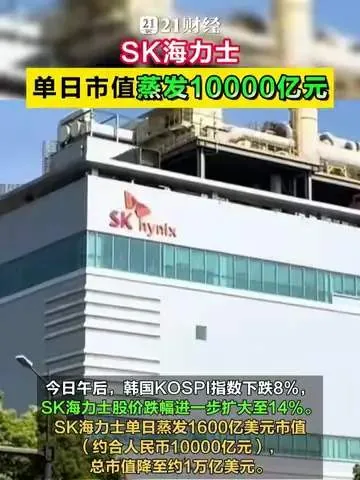
The number is so round it almost feels fake. SK Hynix (SK海力士) — South Korea's memory-chip giant and the world's undisputed king of HBM (High Bandwidth Memory), the secret sauce inside every Nvidia AI GPU — reportedly shed 10,000亿元 (roughly $13.7 billion USD) in market value in a single trading session. That headline has been simmering near the top of Toutiao (今日头条) with a heat score north of 12.6 million — bigger than most C-drama scandals and Pop Mart (泡泡玛特) drop manias combined.
So why does a Korean semiconductor company's bad Tuesday dominate the Chinese algorithm? Pull up a chair.
The HBM Hustle, Explained for Humans Who Don't Read Earnings Calls
Here's the thing about the AI gold rush: everyone obsesses over the picks and shovels (GPUs, TPUs, Ascend chips), but almost nobody talks about the glue. HBM is that glue — stacked DRAM dies sitting millimeters from the compute die, feeding data at speeds regular memory can only dream about. Without HBM3E, your H100 is basically a Ferrari with a lawnmower carburetor.
And who makes essentially all of it? Three companies: SK Hynix (50% market share), Samsung (三星) (40%), and Micron (美光) scraping the remaining ~10%. SK Hynix isn't just a player — it's the bottleneckmaker for the entire global AI buildout. When Jensen Huang needs HBM, he calls Seoul before he calls anyone else.
So when Hynix sneezes, the AI supply chain catches pneumonia. And Chinese netizens — who've been marinating in semiconductor-trade-war content for five straight years — know exactly what a Hynix sneeze means.
Why the Toutiao Crowd Is Glued
Three reasons this particular wipeout broke the Chinese algorithm:
1. Schadenfreude-flavored cope. China's chip ambition has been the defining industrial story since US export controls kicked in around October 2022. Huawei's Ascend (昇腾) line, Cambricon (寒武纪), Moore Threads (摩尔线程), Biren (壁仞) — all fighting uphill against sanctions that locked them out of TSMC (台积电) advanced nodes and, critically, out of HBM. Every time a foreign champion stumbles, there's an unmistakable whiff of vindication. Never mind that Huawei's own Ascend 910B still relies on存量 HBM inventory that's running thin. When Hynix bleeds, the comment sections flood with variants of 天助我也 — heaven helps those who help themselves.
2. The bubble-is-popping anxiety spiral. The smarter Toutiao commenters aren't celebrating. They're sweating. Because here's the uncomfortable truth: if Hynix's guidance softens, it signals that hyperscaler demand for AI accelerators might be cooling. Which means the whole justification for China's massive domestic chip subsidy binge — we must catch the wave, the wave is infinite — starts looking shaky. Nobody on the Chinese internet wants to type this out loud, but the subtext is everywhere: If Nvidia's orders slow down, what happens to our entire national-chip-industrial-policy bet?
3. Pure financial rubbernecking. 10,000亿元 is an absurd number to process. It's roughly the GDP of a mid-tier Chinese province. It's more than the combined valuation of every Chinese AI startup that raised in 2024. Toutiao's user base — heavily male, heavily retail-investor-coded — treats market-cap wipeouts like sports scores. The engagement loop writes itself.
The Real Story: HBM Is the New Oil
Here's what the hot-board discourse is actually circling without saying directly: memory has quietly become the most strategically important semiconductor category, more than logic, more than foundry.
You can fake an ecosystem around a 7nm chip if you're patient and sanctioned enough (see: SMIC (中芯国际), Huawei, the whole Mathe story). You cannot fake HBM. The stacking technology, the TSV (through-silicon via) processes, the yield management — it represents maybe a decade of compounding institutional knowledge concentrated in three companies, all non-Chinese. China's domestic HBM efforts — CXMT (长鑫存储) out of Hefei, a few stealth-mode startups — are years behind. Like, embarrassingly years behind. Think 2027 at the earliest for anything resembling HBM2-class product, and that's optimistic.
This is why the Hynix wipeout trended. Not because Chinese readers love Korean earnings. Because every person on that Toutiao thread with a functioning BS detector knows: the day HBM supply loosens is the day China's AI hardware ambitions become viable. And that day keeps getting pushed further out.
My Take
The Chinese internet's obsession with SK Hynix's market-cap acrobatics is really an obsession with its own cage. The algorithm served this story hot because it touches every neural pathway of contemporary Chinese tech anxiety: semiconductor sovereignty, AI arms-race timing, the bitter taste of sanctions, the hope-against-hope that a foreign champion's stumble might crack open a window.
It won't. Not this quarter, probably not this decade. Hynix could lose another 10,000亿元 tomorrow and CXMT still won't be shipping HBM3 to Huawei. The structural moat is that deep.
But the dream dies hard. And on Toutiao — where semiconductor nationalism has replaced soybean nationalism as the default online mood — the dream is the content. Expect this story to keep cycling back every earnings season. Expect the comment sections to keep split-personality-ing between they're collapsing, we're winning and oh god we're so far behind.
Both are true. That's the tragedy and the comedy of watching the Chinese internet process the chip war in real time.