1,000 Zongzi a Day: The Human Hustle No Robot Can Crack
The headline from Toutiao (今日头条) is almost comically modest: "粽子店阿姨1天包1000多个粽子" — an auntie at a zongzi shop wrapped more than 1,000 rice dumplings in a single day. Nearly 19 million people clicked. If you're not Chinese, you might wonder what the fuss is about. If you are, you're probably already in line.
The Dragon Boat Festival (端午节) falls on June 10 this year, and for the roughly two weeks bracketing it, China's zongzi industrial complex goes into overdrive. Supermarkets stack them in pyramids. WeChat groups swap favorite flavors — sweet red bean or savory pork belly — the eternal Chinese food feud that makes pineapple-on-pizza look quaint. And in the back rooms of countless shops across the country, aunties like the one in this video are folding bamboo leaves, packing sticky rice, and tying string at speeds that would make a factory engineer weep.
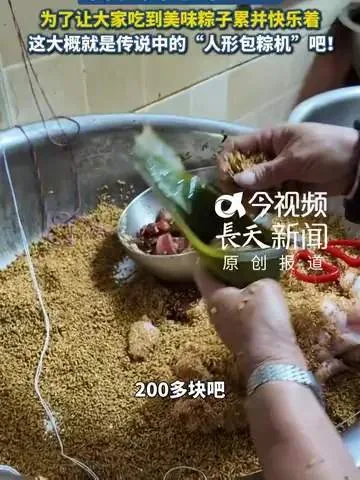
Let's do the math. One thousand zongzi in a day. If she's working a 12-hour shift — and she probably is — that's roughly one every 43 seconds. Each one involves selecting and overlapping two or three bamboo leaves, forming a cone, filling with rice and whatever filling (pork, salted egg yolk, jujube, chestnut), packing it tight, folding the leaves, and binding the whole thing with string. The traditional tying method involves biting one end of the string and wrapping the other around the package in a specific knot pattern. Try it sometime. It's humbling.
Now consider: China is, right now, the world's most aggressive investor in humanoid robotics. Unitree (宇树科技) has its H1 and G1 models doing backflips on Bilibili (B站). Fourier (傅利叶) is shipping the GR-1 for rehab research. Agibot (智元) and UBTech (优必选) are pushing humanoid workers into factory pilots. Shenzhen-based Booster and EngineAI are flooding Douyin (抖音) with bipedal demo videos. And yet — not one of these robots can wrap a zongzi.
This is not a throwaway observation. Zongzi wrapping is exactly the kind of task that exposes the gap between AI hype and physical reality. It requires soft, compliant manipulation of irregular, fragile materials (fresh bamboo leaves tear easily). It demands real-time tactile feedback — feeling when the rice is packed tight enough, when the fold is sealed, when the string tension is right. Roboticists have a term for this: "manipulation in unstructured environments." Last year, a team from Zhejiang University published a paper attempting to teach a dual-arm robot to fold zongzi using reinforcement learning. The robot could wrap one in about 10 minutes with a roughly 40% structural failure rate. The auntie does it in under a minute. Every single time.
So when Toutiao's hot board pushes this story to 18 million impressions, it's not just seasonal filler. There's a quiet pride buried in it — a recognition that some forms of expertise remain stubbornly, defiantly human. The comments section, as you'd expect, is full of people asking how much she earns.
The answer is probably not enough. Seasonal zongzi workers in cities like Jiaxing (嘉兴) — the spiritual capital of Chinese zongzi, home to the legendary Wu Fang Zhai (五芳斋) brand founded in 1921 — can earn anywhere from 3,000 to 6,000 RMB ($415–$830) for the festival season, working brutal hours. Wu Fang Zhai, now publicly listed on the Shenzhen Stock Exchange, produces over 100 million zongzi annually and reportedly uses semi-automated lines for rice preparation and filling. But the final wrapping and tying? Still manual. Still aunties.
This is the contradiction at the heart of China's food manufacturing story. The country has the world's most advanced logistics network — Meituan (美团) delivers hot food in 30 minutes across 1,000-plus cities. It has the most aggressive factory automation push on Earth (over 1.5 million industrial robots installed as of 2023, more than the rest of the world combined). It has a livestream-commerce machine that can sell out a Pop Mart (泡泡玛特) Labubu drop in seconds. But the foods that carry cultural weight — zongzi, jiaozi, hand-pulled noodles — resist full automation because they're not just products. They're rituals.
And this is why the auntie's 1,000-zongzi day resonates beyond the food. In an economy obsessed with scale, efficiency, and disruption, there's something both reassuring and a little melancholy about watching a pair of hands do something a $100,000 robot cannot. It's the same reason Douyin food vloggers like Liziqi (李子柒) rack up billions of views showing traditional countryside cooking. It's why Dong Yuhui (董宇辉) and East Buy (东方甄选) built a following selling agricultural products with literary monologues rather than hard-sell discounts. The human touch sells because the human touch still means something.
The Dragon Boat Festival will pass. The zongzi will be eaten, the bamboo leaves composted, and by July the shops will be back to whatever normal looks like for a seasonal business. The auntie will go home, rest her hands, and probably do it all again next year. The robots, meanwhile, will keep learning. They'll crack it eventually — they crack everything eventually.
But for now, the most impressive manufacturing operation in China during the second week of June is a woman, some leaves, and a ball of string. And 19 million people clicked because they already knew it.