Sedan-Chair Porters and China's Tourism Guilt Trip
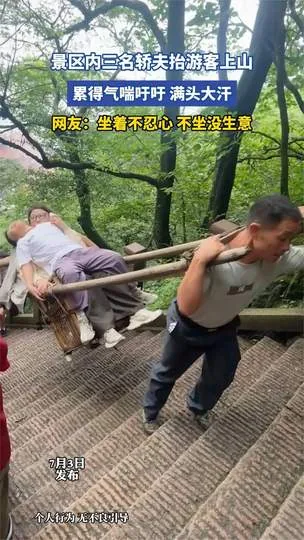
The video is simple, brutal, and now burned into 3.5 million Toutiao (今日头条) feeds: three men in sweat-soaked shirts, bare calves flexing against stone steps, hauling a seated tourist up a mountain trail. Their breathing is audible. The tourist, filmed from behind, sits motionless in a bamboo sedan chair. The caption: "Three sedan-chair porters carry a tourist up the mountain, gasping for breath."
Cue the annual Chinese-internet meltdown.
This footage — and variants of it — cycles through Douyin (抖音), Weibo (微博), and Xiaohongshu (小红书) every few months like clockwork. Each time, the comments section splits into the same three camps:
Camp 1: "Don't hire them, you monster." The tourist is a cosplay-feudalist paying humans to carry them like an emperor.
Camp 2: "Hire them MORE, you monster." Refusing to hire sedan porters takes away their income. They're not slaves; they chose this work. Pay them well, tip heavily, shut up.
Camp 3: "Why doesn't the government ban this?" — usually followed by someone else pointing out that several mountains already tried, and the porters protested because it's their livelihood.
Here's the thing: all three camps are correct, and none of them will ever win.
The 轿夫 economy, in numbers
Sedan-chair porters — 轿夫 (jiàofū) — have been a fixture at China's major pilgrimage-and-tourism mountains for, depending on how you count, either 800 years or forever. Mount Tai (泰山) in Shandong, Mount Huangshan (黄山) in Anhui, Mount Emei (峨眉山) in Sichuan, Mount Hua (华山) in Shaanxi — all of them still operate sedan-chair services alongside cable cars and aerial trams.
Prices vary, but on Mount Tai a ride up the famous Eighteen Bends (十八盘) section can run 400–800 RMB depending on weight, distance, and haggling skills. On Emei, longer routes toward Jinding (金顶, the Golden Summit) can hit four figures. The porters are typically local men in their 30s–50s, often from county-tier (县域) towns, working in rotating teams of three or four.
This is hard, dangerous, old-economy labor in a country that has officially eliminated extreme poverty. That contradiction is precisely why the video keeps going viral.
Why this hits a nerve in 2024 China
China spent the last decade loudly celebrating poverty alleviation. The official line is that nobody should be doing demeaning back-breaking work for tourists anymore. And yet — here are three dudes literally carrying a fourth dude up stone stairs, on camera, in 2024.
The guilt reflex is real. Xiaohongshu posts titled "Should I take the sedan chair on Mount Tai? I feel awful" rack up thousands of comments. Douyin travel vloggers film themselves agonizing at the trailhead. Weibo opinion pieces swing between "ban it entirely" and "you're killing their jobs by being squeamish."
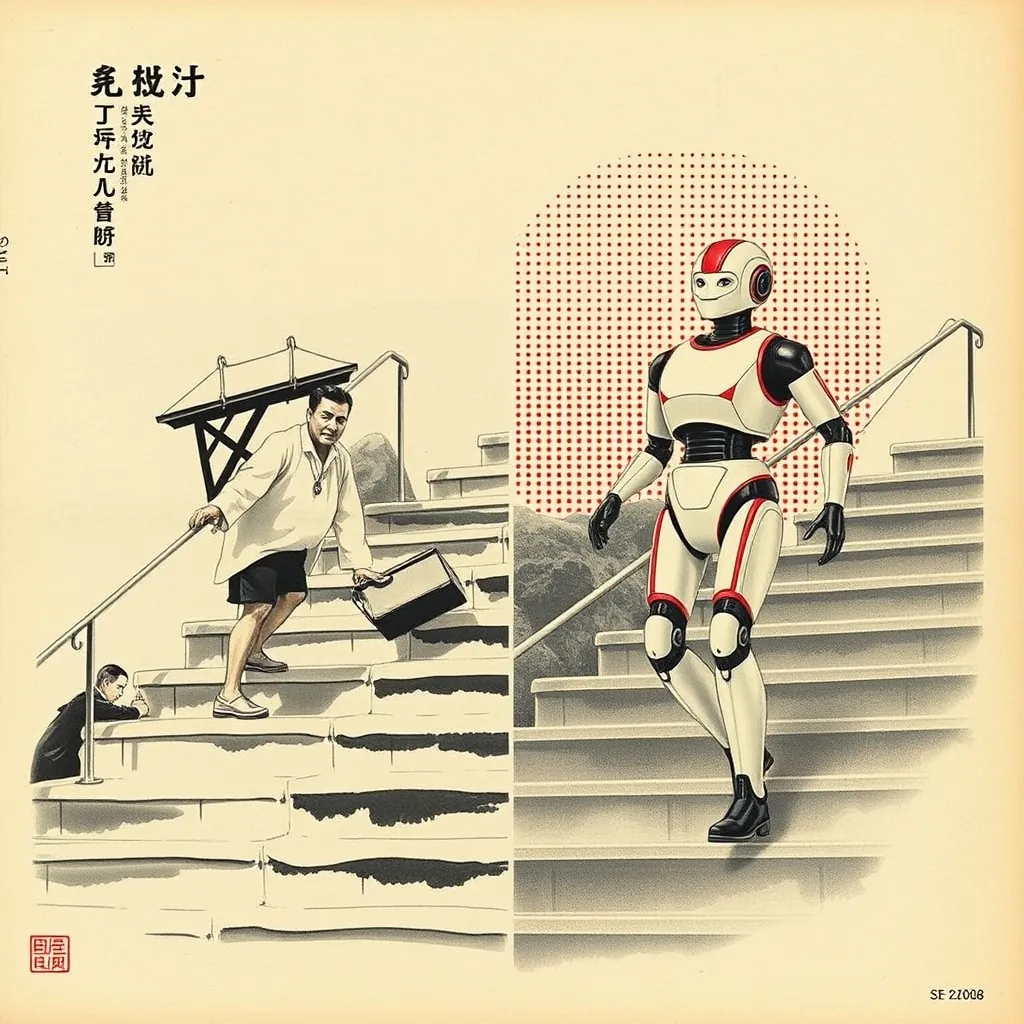
What makes the debate specifically Chinese is the sheer speed of the country's transformation. Twenty years ago, the 轿夫 were just how mountains worked — full stop, no commentary. Today, the same country produces humanoid robots from Unitree (宇树科技), Fourier (傅利叶), and Agibot (智元) — machines theoretically capable of hauling 30kg loads up stairs autonomously. The dissonance between a $2,500 consumer-grade quadruped robot and a 50-year-old man carrying a 70kg tourist up a mountain for 500 RMB is the kind of thing that makes Chinese netizens completely lose their minds.
The robot pivot
Here's the qipaobuzz.com hot take that nobody asked for: the sedan-chair porter is, quietly, one of the most obvious near-term use-cases for Chinese humanoid robotics — and almost nobody in the industry is talking about it publicly.
Unitree's H1 and G1, Fourier's GR-1, and Booster's recently-demoed units can already climb stairs and carry meaningful loads. The technical leap from "trade-show demo at the World Robot Conference" to "electric sedan chair on Mount Tai" is smaller than most people think. The real bottlenecks are battery life on steep inclines, regulatory liability when a robot tumbles down the Eighteen Bends, and — more importantly — the political question of what happens to the 轿夫 when the machines show up.
This is the same dilemma that played out with dockless bikes, food-delivery platforms, and cashier-free convenience stores: Chinese tech moves faster than the labor-market conversation. A robotic Mount Taishan porter fleet is plausible by 2030. Whether it's desirable is a separate, harder question.
My take
The viral video isn't really about the three porters or the one tourist. It's about a China that has gotten rich faster than it has figured out what to do with its remaining manual-labor underclass. Every time this footage surfaces, the comment section is really arguing with itself about whether modernization should mean erasing jobs or preserving dignity — and the 轿夫 are just the most photogenic stand-in for a much bigger national anxiety.
The honest answer for tourists right now: tip your porter generously, treat them as a skilled professional, and for god's sake stop filming their suffering for engagement metrics. And if you're a Chinese robotics founder reading this — the mountain-tourism porter replacement market is sitting right there, worth hundreds of millions annually across just the top five mountains. Just remember that the men currently doing the job are not bugs in your business model. They're the reason the market exists at all.
Three men, one tourist, one mountain, 3.5 million views. The algorithm doesn't care about the ethics. But you should.