AI Photo of a Street Sweeper Just Won a Real Photography Contest
There's a special kind of irony that only the Chinese internet can deliver, and this week it came packaged as a photography award.
A photography competition — details still bubbling across Toutiao (今日头条) and Weibo (微博) — awarded its first prize to a photograph of a sanitation worker. Grainy, emotional, dignified. The kind of image that makes you stop scrolling and feel something about the invisible labor holding a city together.
Except it wasn't a photograph. It was generated by AI.
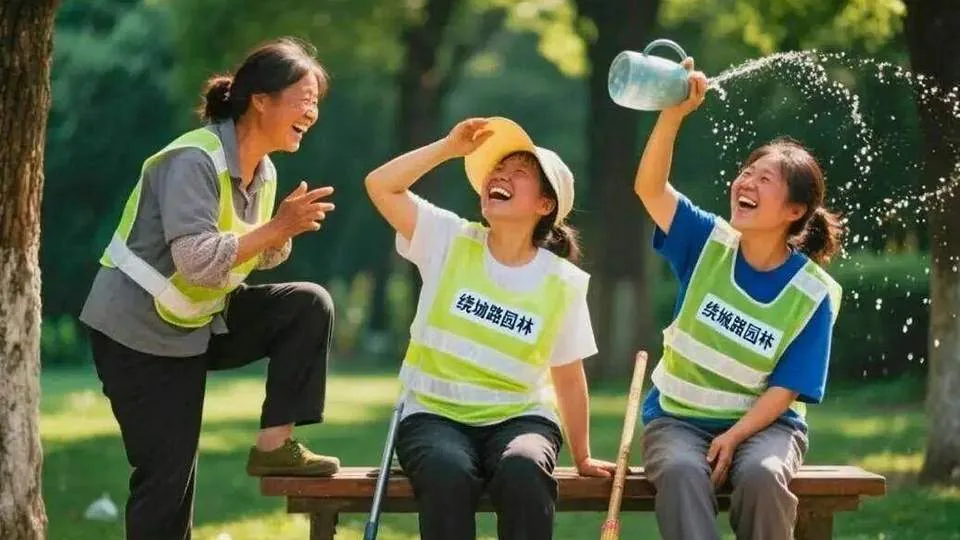
The headline — 「AI生成环卫工照片获摄影比赛一等奖」 — racked up nearly 13 million热度 on Toutiao's hot board, and for good reason. It's the kind of story that makes everyone furious for a different reason. Photographers are furious because they spent years learning composition, lighting, timing, and patience — and lost to a prompt. AI skeptics are furious because a machine fabricated a human story and won praise for "capturing" something it never witnessed. AI enthusiasts are furious that people are upset, because "isn't this just a new tool?" And sanitation workers — the actual subjects — were never consulted, because they don't know this happened and honestly have bigger problems.
This is the contest nobody wins but everyone uses as a weapon.
Let me be clear about where I stand: this is fraud dressed as innovation.
Photography is not just image production. The craft is about being there. It's the photojournalist who waits six hours in the cold for the right moment. It's the eye that sees dignity in a person society ignores. When you type "elderly sanitation worker, golden hour, cinematic, emotional, award-winning" into Midjourney or a domestic equivalent, you're not photographing a worker — you're inventing one. There is no human being behind those pixels. There's no morning shift. There's no story. There's a statistical prediction that this arrangement of pixels will make a human viewer feel something.
And it worked. That's the chilling part.
Now, China's AI image generation scene is no joke. Domestic models like Tongyi Wanxiang (通义万相 by Alibaba), Baidu's ERNIE-ViLG (文心一格), and the open-source juggernaut FLUX — heavily used by Chinese developers — can produce photorealistic outputs that would have seemed impossible eighteen months ago. Tencent (腾讯), ByteDance (字节跳动), and smaller labs are all pushing diffusion models that rival anything coming out of the West. The technical achievement is real and worth respecting.
But technical capability is not moral license.
The deeper issue — and the reason this story trended so hard — is that it exposes a fault line running through Chinese internet culture right now. On one side: the relentless, breakneck adoption of AI tools across every creative industry, from Douyin (抖音) content farms to Xiaohongshu (小红书) lifestyle influencers generating "travel photos" of places they've never visited. On the other: a growing unease that nothing is real anymore, and that human craft is being systematically devalued by machines that learned from human craft without asking or paying.
This sanitation worker photo is a perfect flashpoint because it combines two loaded elements. First, the subject: sanitation workers are symbols of working-class struggle and urban sacrifice in China. Using a fake image of one to win an award feels exploitative — it borrows real suffering for aesthetic clout. Second, the medium: a photography competition specifically exists to honor the act of seeing. Entering an AI image is like entering a robot in a marathon and arguing it counts because it crossed the same finish line.
The Bilibili (B站) commentary has been brutal. Comments range from "this is the death of photography" to detailed threads explaining why the image's metadata, lighting inconsistencies, and impossible background geometry should have been caught by judges. Some users are calling for the competition organizers to be named and shamed. Others are arguing the real scandal is that the judges couldn't tell the difference — which suggests they weren't evaluating craft at all, just emotional impact.
That last point stings because it's probably true.
Here's my take: AI image generation is a legitimate creative tool. I use it. You probably use it. It's going to reshape commercial art, stock photography, game assets, and a hundred other fields. But the boundary between "tool" and "substitute" matters enormously, and it matters most in spaces built around human witness — photojournalism, documentary photography, and any competition that claims to honor the photographic craft.
If you enter an AI-generated image in a photography competition, you should be disqualified. Not because AI art isn't "real" art — that's a boring debate — but because the category exists to reward a specific human skill. You wouldn't enter a synthesized voice in an opera competition. You wouldn't enter a 3D-rendered building in an architecture photography contest. The medium is the point.
What this story really reveals is speed blindness. China's internet moves so fast that institutions — competition organizers, media outlets, awards committees — can't keep up with the technology. The judges likely had no protocol for detecting AI-generated images. The competition probably had no rule explicitly banning them. And by the time the internet caught it, the prize had already been awarded, the headlines had already been written, and everyone involved was in damage-control mode.
Expect more of this. A lot more.
The next few years in China's creative internet are going to be a nonstop game of AI-image whack-a-mole. Photography competitions, illustration contests, short story awards, even academic paper illustrations — all of them are about to get flooded with AI submissions, and most judges are unprepared. The platforms that move fastest to establish clear rules — "AI-assisted" categories, mandatory disclosure, metadata verification — will earn trust. The ones that don't will keep getting embarrassed on the Toutiao hot board.
As for the sanitation worker in the photo: they don't exist. They never woke up at 4 a.m. They never swept that street. And somewhere in China, a real sanitation worker did wake up at 4 a.m. and swept a real street, and nobody took their photo, and nobody gave them a prize.
That's the part the AI can't generate.