China Burned 6.9% More Electricity — And The AI Labs Are Why You Should Care
China's National Energy Administration just dropped a number that sounds boring but is anything but: total electricity consumption across the entire society grew 6.9% year-on-year. That's "全社会用电量同比增长6.9%" for those of you following the Toutiao (今日头条) hot board, where this headline is currently sitting with over 8.2 million heat units and climbing.
Here's why this matters more than your usual macroeconomic snoozefest: China's power demand is growing faster than its GDP. That gap — electricity outpacing economic output — is a screaming signal that something electricity-hungry is being built at industrial scale. And if you've been reading this blog, you already know what it is.

The AI arms race is an electricity story.
Every single Chinese AI lab we track on this site is in a bare-knuckled compute arms race. DeepSeek (深度求索) shocked the world with cost-efficient training, but even efficient models need server farms the size of shopping malls. Alibaba's Qwen (通义千问) team is churning out model variants like a factory production line. ByteDance's Doubao (豆包) is serving hundreds of millions of consumer queries daily. Kimi (月之暗面/Moonshot) burns cash on long-context inference that makes electrical engineers weep. Zhipu's GLM (智谱清言), MiniMax (稀宇科技), Baichuan (百川), 01.AI (零一万物) — they're all standing up GPU clusters that drink megawatts like milk tea.
A single large AI training run can consume as much electricity as a small town. Now multiply that across dozens of labs, each running multiple models, each iterating constantly to keep up with benchmark wars. The electricity bill isn't a footnote — it's the actual battlefield. When we talk about China's "AI gap" with the United States, we're really talking about three things: chips, talent, and watts. China can't easily solve the first (thanks, export controls), is aggressively developing the second, but the third? The third is where China's industrial policy muscle and State Grid infrastructure actually give it a structural advantage.
The 6.9% number is the receipt.
Beyond AI: the hardware revolution eats power too.
Then there's the physical tech buildout. Unitree (宇树科技) is manufacturing humanoid robots that will eventually populate factories. Fourier (傅利叶) GR-1, Agibot (智元), UBTech (优必选) — the robotics pipeline from prototype to mass production requires enormous manufacturing capacity. China's factory-automation push means more robotic arms, more precision machining, more industrial compute — all drawing from the same grid.
Huawei's Ascend (昇腾) chips and the domestic semiconductor push from companies like Cambricon (寒武纪) and Moore Threads (摩尔线程) represent a whole parallel computing ecosystem being willed into existence. Building chips is energy-intensive. Building the data centers to house them is energy-intensive. Training the models that justify the chips is energy-intensive. It's turtles all the way down, and every turtle has a power cord.
The consumer layer: streaming, gaming, and midnight hotpot deliveries.
Don't sleep on the consumer side. Douyin (抖音) serves short video to 700+ million daily active users — the recommendation algorithms alone require staggering compute. Tencent (腾讯) runs the world's largest gaming infrastructure. Meituan (美团) dispatches food delivery across thousands of cities with real-time route optimization. Pinduoduo (拼多多) and its agricultural supply-chain logistics run on machine learning models that never sleep. Xiaohongshu (小红书) is indexing lifestyle content for 300 million users. Bilibili (B站) is encoding and streaming user-generated video at massive scale.
Every livestream shopping session — whether it's Dong Yuhui (董宇辉) on East Buy (东方甄选) selling agricultural products or some random county-tier influencer moving Pop Mart (泡泡玛特) blind boxes — represents compute cycles somewhere. China's consumer internet is not just software. It's physical infrastructure, and that infrastructure has a carbon footprint.
The real story: industrial structure is shifting.
Here's my opinionated take. The 6.9% figure, while seemingly modest, reveals something structural. China's economy is rebalancing from export-manufacturing toward a services-and-technology model, but that transition is electricity-intensive in ways policymakers didn't fully anticipate a decade ago. The old assumption was that a service economy would be lighter on energy. Wrong. Digital services are heavy. AI is heavy. Cloud computing is heavy. The entire stack — from the chips to the models to the consumer apps to the delivery drones — runs on electricity.
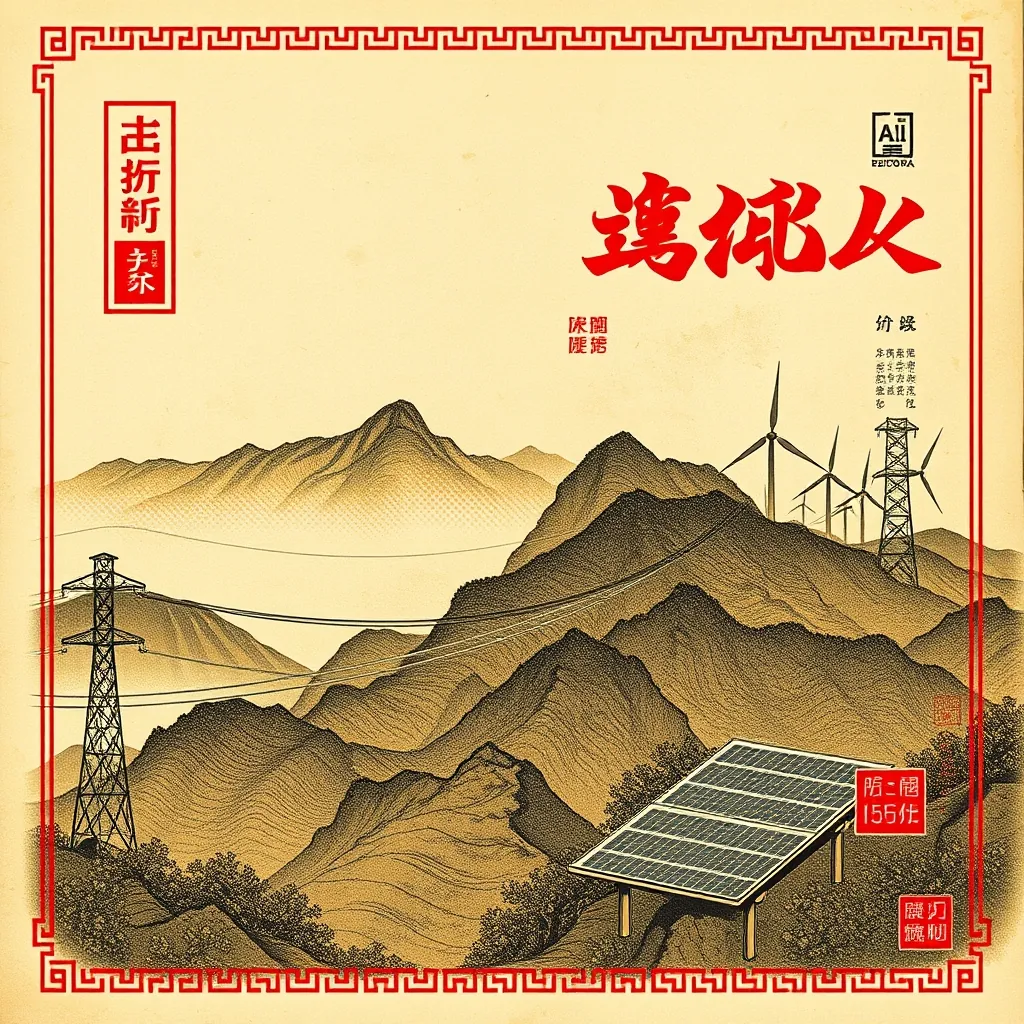
This is why China is building renewables at a pace that makes the rest of the world look complacent. Solar installations, wind farms, hydro expansion, nuclear — the energy transition isn't just climate policy. It's industrial survival. If China wants to win the AI race, build the robotics industry, and maintain consumer-internet dominance, it needs to keep the lights on and the GPUs fed.
The 6.9% electricity growth number isn't boring at all. It's the skeleton key to understanding China's entire technology strategy. Every data center built is a bet on the future. Every kilowatt-hour consumed is a down payment on relevance.
So next time you see a Chinese AI model drop a benchmark result, or a robotics startup shows a slick demo video, remember: behind every parameter and every motor joint, there's a power plant somewhere in Inner Mongolia or Yunnan, turbine spinning, keeping the whole dream alive.
The grid tells no lies. And the grid says China is betting the farm.