China's Robot Conquers America's Got Talent—and Chinese Internet Loses It
Something unprecedented happened on America's Got Talent this week, and it wasn't another singer forgetting the lyrics to "I Will Always Love You." A Chinese-made humanoid robot strode onto that hallowed stage and performed for the American public, and the Chinese internet absolutely lost its collective mind.
The headline 「中国机器人登上美国达人秀」 has been rocketing across Toutiao (今日头条) with over 7 million views and counting, and honestly? The vibes are immaculate. This is the moment China's robotics sector has been building toward—not some dry industrial demo or a carefully curated trade show booth, but pure, uncut mainstream American entertainment.
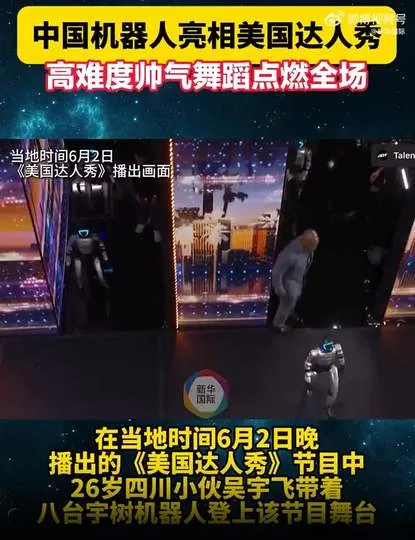
Let's be real about what's happening here. When a Chinese robot shows up on one of America's most-watched television shows, it's not just a tech demo. It's a cultural moment. It's the robotics equivalent of Yao Ming stepping onto an NBA court for the first time—except this time, the athlete is made of aluminum alloys and servo motors.
The Chinese internet reaction has been fascinating to watch. On Weibo (微博), the hashtag related to this performance has been generating thousands of comments per hour. On Douyin (抖音), clips are being remixed with everything from patriotic anthems to comedic sound effects. Bilibili (B站) users are doing what they do best—creating elaborate analysis videos breaking down every technical detail of the robot's movements.
And the pride is palpable, but it's a specific kind of pride. It's not the chest-thumping nationalism you might expect. It's more like... vindication? Like, "Oh, you thought we could only manufacture your iPhones? Watch this."
Here's what makes this moment genuinely significant beyond the feel-good vibes: China's humanoid robotics sector has been quietly having its breakout year. Companies like Unitree (宇树科技) with their H1 and G1 models, Fourier (傅利叶) with the GR-1, Agibot (智元) with their Yuanzheng series, and UBTech (优必选) have all been making serious moves. These aren't lab prototypes anymore—they're products, they're performing, and apparently, they're ready for primetime American television.
The timing couldn't be more perfect. While the West has been obsessing over AI chatbots and generative models—important, yes, but essentially software—China has been going deep on embodied AI. The thinking is straightforward: if AI is the brain, robots are the body, and China has always been better at building things you can touch.
What the AGT appearance reveals is how Chinese robotics companies are thinking about market positioning. You don't go on America's Got Talent to sell industrial automation systems. You go there to build brand awareness, to create emotional connection, to make people feel something about your technology. It's the same playbook Boston Dynamics used with their viral robot videos—except now it's Chinese companies writing the script.
The economic subtext is impossible to ignore. China's consumer electronics sector has been searching for the next big thing after smartphones. The smartphone market is saturated, growth has plateaued, and everyone from Shenzhen to Shanghai is looking for the next category-defining product. Humanoid robots—eventually destined for homes, not just factories—represent a potential multi-trillion-yuan opportunity.
But here's the thing about the Chinese internet's reaction that I find most telling: there's genuine surprise mixed with the pride. Comments like "I didn't know our robots were this good" and "This feels like sci-fi but it's real" suggest that even Chinese consumers haven't fully internalized how far their domestic robotics sector has come. The AGT moment isn't just flexing to Americans—it's educating Chinese citizens about their own technological capabilities.
The entertainment factor matters enormously too. Chinese tech companies have historically struggled with the "cool factor." Huawei makes great phones but they're not exactly lifestyle brands. DJI dominates drones but their products feel more professional than cultural. A robot performing on AGT? That's cool. That's shareable. That makes robotics feel less like industrial policy and more like the future arriving ahead of schedule.
From a pure competitive standpoint, this is also a shot across the bow at American and Japanese robotics companies. Figure AI, Tesla's Optimus, Honda's ASIMO (RIP)—the West and Japan have been the face of humanoid robotics for decades. China crashing the party via a reality TV show is peak disruptive energy. It's the technological equivalent of showing up to a black-tie gala in a designer tracksuit—you can be mad about it, but you can't look away.
The viral moment also highlights something unique about China's innovation ecosystem: the speed from lab to stage. In many countries, a robotics breakthrough would be published in a paper, demonstrated at a conference, maybe featured in a trade publication, and eventually—years later—make it to mainstream awareness. In China's hyper-competitive, content-obsessed market, that timeline compresses to months. If you've got something impressive, you'd better show it off immediately before someone else does.
Looking ahead, expect more of this. Chinese robotics companies have realized that viral moments drive investment, talent acquisition, and consumer interest. The AGT appearance won't be the last time a Chinese robot does something designed specifically to break the internet. And with companies like XPeng (小鹏) developing their IRON robot, EngineAI pushing boundaries, and startups like Robot Era emerging seemingly monthly, the supply of headline-ready robots is only growing.
The bottom line? That Chinese robot on America's Got Talent isn't just a novelty act. It's the opening act of a much bigger show. China's robotics revolution isn't coming—it's here, it's got prime-time billing, and it just might steal the whole damn performance.
Grab your popcorn. The next act is going to be wild.