China's Robot Cowboy Rides Onto TIME
When was the last time a Chinese robotics founder got the full TIME magazine cover treatment? Because that just happened, and the Chinese internet is losing its collective mind over it.
Wang Xingxing (王兴兴), the 34-year-old founder and CEO of Unitree Robotics (宇树科技), has landed on the cover of TIME with one of his humanoid robots like he's about to challenge Optimus to a parking-lot duel. The headline trending on Toutiao (今日头条) — "宇树CEO携载人机甲登《时代》封面" — has racked up over 1.2 million heat points and climbing. Translation for those who don't read hot-board tea leaves: this is currently one of the top-five things the entire Chinese internet is talking about.
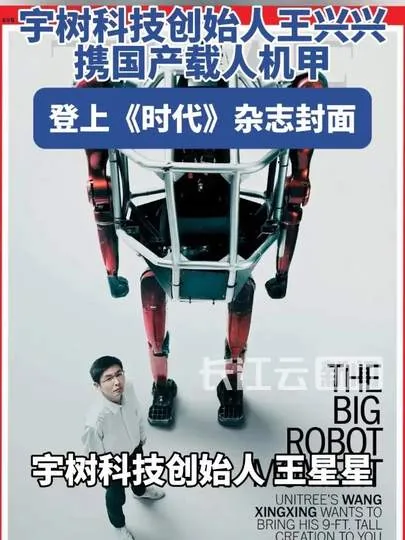
And honestly? They should be. Because this isn't just a robotics story. This is a story about how Chinese hardware companies have stopped apologizing for existing.
Let me set the scene. Unitree, founded in 2016 in Hangzhou, spent its early years making robot dogs — the quadruped kind that look like they wandered off a Boston Dynamics set and got lost in a Pinduoduo (拼多多) warehouse. They were good. Genuinely good. The Go1 and Go2 models undercut Boston Dynamics' Spot by an order of magnitude while being lighter, faster, and weirdly more agile. But in the Western press, Unitree was mostly treated as a "budget clone" story. Cute Chinese company makes cheaper robot dog. Insert tariff joke here.
Then 2024 happened.
Unitree's H1 humanoid — a full-size bipedal robot standing 180cm tall — started showing up in videos doing backflips, pouring drinks, and walking through obstacle courses with a casualness that made Tesla's Optimus look like it was perpetually tipsy at a company holiday party. At WRC 2024 (World Robot Conference in Beijing), Unitree's booth was mobbed. I mean mobbed. People were six-deep trying to get selfies with the G1, the consumer-grade humanoid that starts at around $16,000 — roughly the price of a decent used car, except this one can do your laundry and scare your cat.
The G1 launch was the moment the Chinese robotics community realized something had shifted. Here was a humanoid robot you could actually buy, with a deposit, on a website, shipped to your door. Not a demo unit. Not a "contact sales" situation. An actual product with an actual price tag.
Now Wang is on TIME.
Here's what the Chinese internet is actually saying, decoded:
On Weibo (微博), the dominant sentiment isn't just pride — it's vindication. The top-voted comment on the trending hashtag translates roughly to: "Remember when everyone said Chinese robotics was five years behind? Looks like the five years just evaporated." Another popular take: "First DeepSeek (深度求索) made Silicon Valley panic, now Unitree is making them pose for photos." The DeepSeek comparison is doing serious cultural work here — Chinese netizens have internalized the narrative that 2025 is the year domestic tech stopped chasing and started leading.
On Bilibili (B站), the commentary is predictably more technical and more snarky. Robot enthusiasts are analyzing the cover image frame-by-frame, debating whether the robot shown is a modified H1 or a new variant. The running theory: it's an H1 with upgraded actuators and the new "smart hands" Unitree teased last month. Someone has already done a side-by-side pixel analysis. This is your reminder that B-station commenters will forensically examine anything.
But here's the angle that Western coverage is going to miss: Wang Xingxin's personal story is peak Chinese tech mythology right now. He's not a returned PhD from MIT. He didn't spin out of a national lab. He started building robots as a grad student at Zhejiang University, couldn't afford fancy parts, and literally welded his own frames in a dorm room. The origin story of Unitree is a guy who couldn't buy the robot he wanted, so he built one, and then built a company to build more.
That narrative — scrappy, self-taught, resource-constrained but obsessed — is exactly the story Chinese consumers want to hear right now. It's the Dong Yuhui (董宇辉) energy applied to hardware. The idea that you don't need a Stanford pedigree or a government grant to build world-class technology. You need a welding torch and a problem you can't stop thinking about.
The TIME cover also lands at a fascinating cultural moment. Chinese humanoid robotics is in full land-grab mode. You've got Fourier (傅利叶) with the GR-1 targeting medical and rehab applications. Agibot (智元), founded by former Huawei exec Peng Zhihui (the "Huawei Genius Boy"), is going hard on embodied AI for manufacturing. UBTech (优必选) has Walker robots doing shifts at BYD factories. XPeng just showed off IRON. EngineAI, Booster, Robot Era — new humanoid startups are launching every month. The Chinese government has made humanoid robots a national priority under the 2023 "robot industry development plan," and provincial subsidies are flowing.
But Unitree is winning the cultural moment because they've mastered something their competitors haven't: spectacle. Wang doesn't just build robots. He puts them in music videos. He has them dance on stage at product launches. He releases clips of them doing martial arts forms. The TIME cover isn't a surprise — it's the logical extension of a company that understands in 2025, the product IS the content.
Chinese internet culture has fully absorbed this lesson from the consumer internet era — from Douyin (抖音) virality to Pop Mart (泡泡玛特) hype cycles — and Unitree is applying it to industrial robotics better than anyone. Boston Dynamics spent fifteen years building the most technically impressive robots on Earth and fumbled the brand. Unitree spent eight years building technically-impressive-enough robots and turned the brand into a movement.
The hot take from qipaobuzz: the next global consumer hardware brand won't come out of Cupertino. It'll come out of Hangzhou, Shenzhen, or Beijing, and it might just have a face that lights up when it sees you.
Wang Xingxin on TIME is the signal. The scramble is officially on.