Jensen Huang x Unitree: The 1.8m Robot That Broke Toutiao
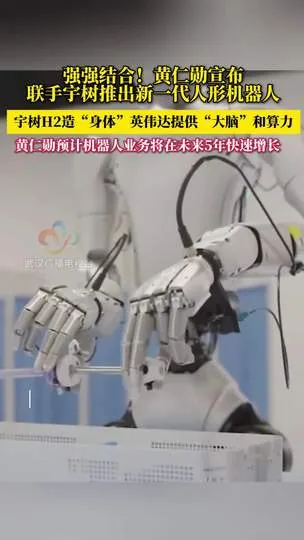
Someone pinch me. The trending board on Toutiao (今日头条) is currently losing its collective mind over a headline that reads like sci-fi fanfic cooked up by a crypto bro at 3 AM: "Jensen Huang partners with Unitree to build a 1.8-meter robot." Nearly 6 million hot score. Six. Million.
Let's unpack this beautiful chaos.
First, the players. Jensen Huang (黄仁勋) — yes, that Jensen Huang, the leather-jacket-wearing CEO of NVIDIA who has become an unlikely folk hero across the Chinese internet. The man can barely sneeze without it trending on Weibo (微博). He's basically treated as a tech demigod by Chinese netizens, which is both hilarious and completely understandable given that every AI lab from DeepSeek (深度求索) to Qwen/Tongyi (通义千问) to Zhipu (智谱清言) desperately needs his chips to train their models.
Then there's Unitree (宇树科技), the Hangzhou-based robotics company that's been aggressively making waves with their humanoid platforms like the H1 and G1. You've probably seen their robots doing backflips on Douyin (抖音) or getting kicked by engineers to demonstrate balance recovery (a move that frankly feels like a metaphor for the entire Chinese tech sector). Unitree has positioned itself as the scrappy Chinese answer to Boston Dynamics — except they actually sell their robots at prices that don't require a defense contract.
Now, the claim: a 1.8-meter humanoid robot born from this partnership. That's roughly 5'11" for my American friends — taller than the average Chinese man and approximately the same height as Jensen Huang himself. Coincidence? I think not. The man is literally building a robot in his own image.
Here's why this matters beyond the obvious "cool robot bro" factor.
China's humanoid robotics space is absolutely on fire right now. You've got Fourier (傅利叶) with their GR-1, Agibot (智元) pushing their Yuanzheng series, UBTech (优必选) making factory-ready units, XPeng's IRON project, and newcomers like EngineAI and Robot Era all scrambling to build the dominant humanoid platform. It's a crowded field, but Unitree has consistently differentiated itself through aggressive pricing and genuinely impressive viral marketing.
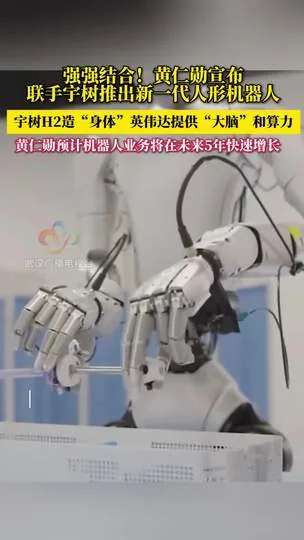
The Jensen Huang connection is the real juice here though. NVIDIA doesn't just make chips — they've been building out an entire robotics ecosystem through their Isaac platform and Jetson edge computing modules. If Unitree is getting deeper integration with NVIDIA's robotics stack, that's not just a partnership headline — that's a potential moat. Chinese robot builders have been hampered by chip access issues (thanks, export controls), so any company that can maintain a strong relationship with NVIDIA while navigating the geopolitical minefield has a massive advantage.
But let's be real about what's actually happening here. The Chinese internet's obsession with this headline reveals something deeper about the current tech zeitgeist. There's a potent cocktail of pride and anxiety driving engagement. Pride that a Chinese company like Unitree is seen as worthy of partnering with the king of AI chips. Anxiety that without access to the best chips, Chinese robotics could hit a ceiling. And underneath it all, that unmistakable Chinese internet energy where any story about humanoid robots instantly generates memes, fan art, and heated debates about whether robots will take our jobs (spoiler: yes, but also create new ones, but also we're all gonna die, but also the robot dogs are kinda cute).
The numbers tell the story. Nearly 6 million on the Toutiao hot board isn't just "trending" — it's dominating. For context, that's more engagement than most celebrity divorce scandals and food safety scandals combined. Chinese netizens care about robots the way Americans care about football. It's become a genuine cultural phenomenon.
What's particularly interesting is how the Chinese commentariat frames this. Scroll through the comments and you'll see three distinct camps:
Camp One: Uncritical hype merchants who treat every robot video as proof that China has already won the future. These are the people who comment "厉害了我的国" under literally anything with circuits.
Camp Two: Earnest tech enthusiasts who actually understand kinematic control systems and want to discuss torque density. Bless them. They are the backbone of Bilibili (B站) tech content and I would die for them.
Camp Three: The doomer-optimists who oscillate between "this is terrifying" and "I want one to do my laundry" within the same sentence. This is the majority. This is the spirit of the Chinese internet.
Look, I don't know if this specific 1.8-meter robot will be the one that changes everything. The hype cycle around humanoid robots has repeatedly promised Jetsons-level domestic help and delivered expensive demo units that can barely open a door. But the trend line is undeniable. Chinese robotics companies are moving fast, partnering aggressively, and capturing public imagination in ways that Western competitors simply aren't matching.
Unitree specifically has been genius at playing the viral game. Their robot dogs have become genuine internet celebrities. Their humanoid clips rack up tens of millions of views. And now they've got the ultimate co-sign from the most important man in AI hardware.
Whether this partnership produces a groundbreaking robot or just more viral videos remains to be seen. But one thing's certain: Chinese internet culture has decided that humanoid robots are the main character of 2024, and nothing — not Pop Mart (泡泡玛特) hype, not milk tea wars, not even Dong Yuhui (董宇辉) livestream drama — can steal that spotlight right now.
The robot uprising is being televised, and it's trending at 5.9 million on Toutiao. Stay weird, China.