The Million-RMB Cyber Companion: Who's Actually Buying?
Toutiao (今日头条) is ablaze with a question that sounds like dystopian satire but is dead serious: Who's dropping nearly a million yuan on a "cyber companion" (赛博伴侣)? The headline — pulling 27.8 million hot-score signals — isn't about some niche fetish subculture. It's about the bleeding edge of Chinese consumer AI, where humanoid robotics, large language models, and good old-fashioned loneliness economics collide into one very expensive package.

Let's decode. "Cyber companion" in today's Chinese internet parlance covers a spectrum: from AI chatbot girlfriends/boyfriends powered by models like DeepSeek (深度求索) or Qwen (通义千问), all the way to full physical humanoid robots that can walk, talk, and theoretically cuddle. The "nearly a million" (近百万) price tag? That's the premium tier — think customized humanoid platforms from companies like Fourier (傅利叶) whose GR-1 robot has been marketed as a general-purpose humanoid, or Unitree (宇树科技) whose H1 and G1 models have gone viral for their unsettlingly smooth dance moves and backflips. Strip away the PR and you realize: China's robotics labs are now openly building the girlfriend/boyfriend hardware platform, even if they won't say it that bluntly.
Here's where it gets revealing. The Chinese internet's reaction isn't mockery — it's market research. Comment sections on Toutiao and Weibo (微博) are flooded with surprisingly pragmatic questions: Can it cook? Does it remember conversations? What's the battery life? How realistic is the skin? This isn't a joke thread; it's a focus group. Chinese consumers, particularly the stressed-out urban professionals and the legendarily lonely rural bachelors (the 光棍 or "bare branches"), are treating humanoid companion robots as a legitimate product category — not a sci-fi curiosity. The fact that commenters are debating specs rather than morality tells you everything about where Chinese consumer tech culture is right now.
The software side is already mainstream. Apps like Doubao (豆包) from ByteDance (字节跳动) and Kimi (月之暗面/Moonshot) have quietly absorbed millions of users who engage in extended, emotionally intimate conversations with AI personas. Zhipu's (智谱) GLM models and MiniMax (名之梦) have powered character-AI platforms where users spend hours daily — sometimes paying subscription fees for premium "relationship" features. The emotional AI market in China is estimated in the billions of yuan already. The "million-yuan cyber companion" headline is simply the hardware escalation of something that's been happening in software for two years.
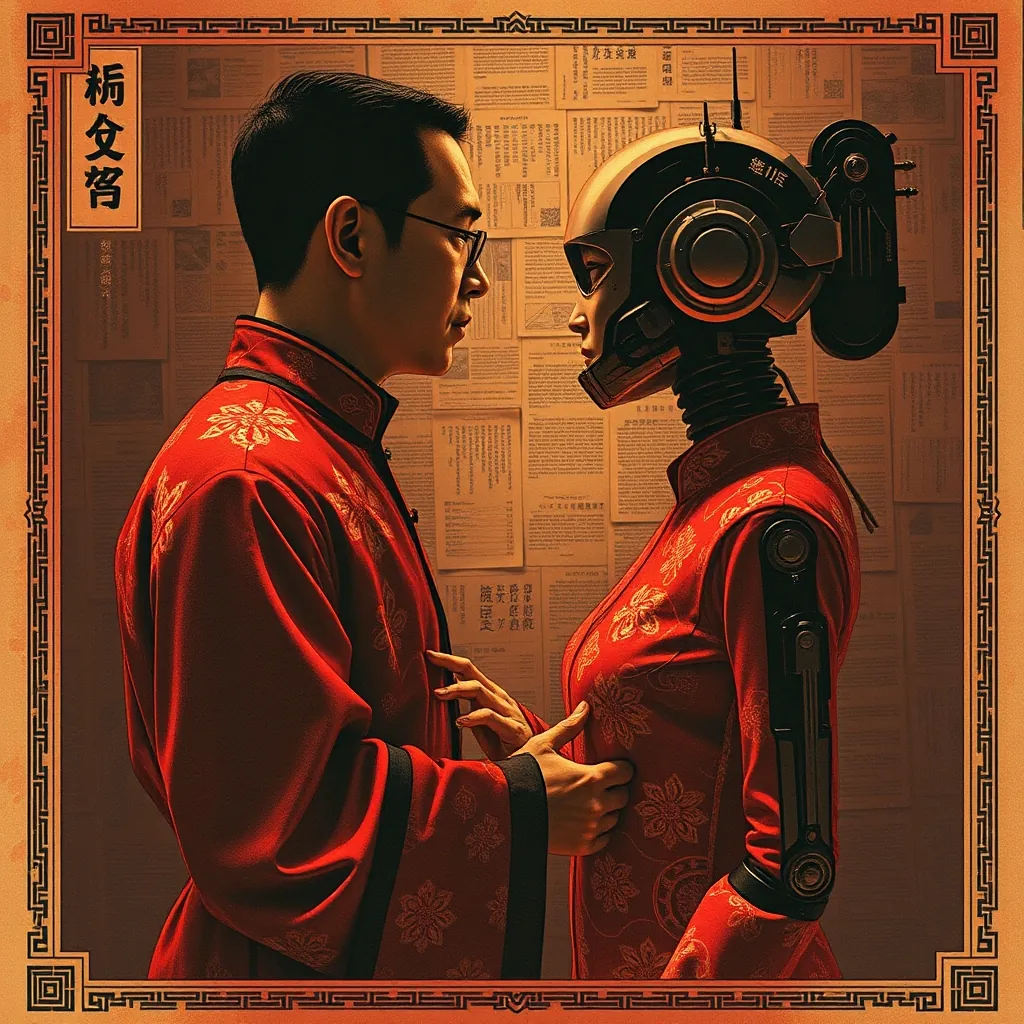
But who actually buys the hardware version at that price? Three cohorts emerge from the discourse. First: wealthy tech enthusiasts — the same guys who dropped 200,000 yuan on early Tesla-adjacent gadgets or queued for limited-edition Pop Mart (泡泡玛特) Labubu drops. For this demo, a million-yuan robot is a flex, a conversation piece, the ultimate Douyin (抖音) unboxing content. Second: accessibility buyers — families with elderly parents who need companionship and basic physical assistance, where the math against hiring full-time human caregivers actually starts to pencil out in tier-1 cities. Third — and this is the one nobody wants to say aloud — the desperate. China's loneliness crisis is real, structural, and mostly unspoken. When Xiaohongshu/RED (小红书) posts about AI relationships routinely gather tens of thousands of likes, you're not looking at edge cases.
The Chinese robotics industry is paying attention. Agibot (智元), founded by Huawei veteran Zhi Zhengyao, has explicitly marketed its "Yuanzheng" (远征) series toward home environments, not factories. UBTech (优必选), long a player in educational robots, has pivoted hard toward humanoid platforms with companion capabilities. EngineAI, Booster (星动纪元), Robot Era — the entire Chinese humanoid startup ecosystem knows that the consumer companion use-case is the volume play, not industrial automation. B2B humanoid deployments are slow, capital-intensive, and require safety certifications. A rich lonely guy with a million yuan? That's a sale you can close on Douyin.
My take: the headline is slightly ahead of the market but not wrong. The current generation of humanoid robots at that price point remain demo-quality — impressive in curated videos, frustrating in living rooms. Battery life, conversational memory, physical reliability, and that uncanny valley problem all remain unsolved at scale. But the demand signal is unmistakable and the Chinese commentariat knows it. When a Toutiao headline about million-yuan robot companions generates more engagement than most celebrity scandals, you're watching a consumer category being born in real-time. The question isn't whether cyber companions arrive — China's AI labs and robotics startups are sprinting toward that future. The question is whether they can get the price down to 100,000 yuan before public fascination curdles into disillusionment. Because in China's consumer tech cycle, hype has a shelf life — and the clock is already ticking.
One thing's certain: the companies that crack emotional AI plus functional humanoid hardware at an accessible price won't just win a market. They'll reshape how an entire generation of Chinese people experiences companionship itself. And that's either the greatest consumer tech opportunity of the decade or the saddest. Possibly both.