Dog Feasts on Raw Pork in Chinese Supermarket, Workers Shrug
Something you need to understand about Chinese internet culture: nothing—nothing—gets people more riled up than food safety scandals combined with visible apathy. Enter today's viral moment from Toutiao (今日头条), where a video showing a stray dog casually gnawing on raw pork in a supermarket while a porter literally walks past without a care has ignited over 5.3 million views and counting.
The footage, presumably captured by a shocked customer, shows exactly what the headline promises: a dog, front paws up on the meat display, chowing down on unpackaged pork like it owns the place. A worker—identified as a porter/mover—glances at the scene and just... keeps walking. Not his circus, not his monkeys. Or in this case, not his dog, not his pork.
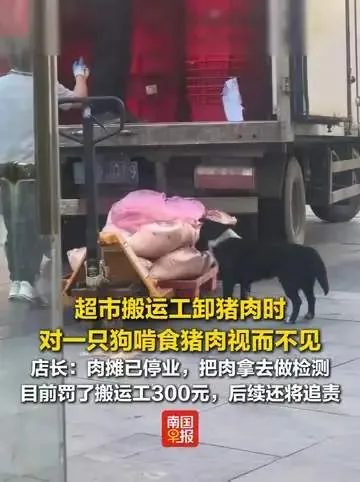
Now, if you're thinking "well, that's just a stray dog being a dog," you're missing about two decades of Chinese food safety trauma. This is a country where the 2008 melamine milk scandal poisoned 300,000 babies and killed six. Where "gutter oil" (地沟油)—literally recycled waste oil—was a persistent nightmare for anyone eating at restaurants throughout the 2000s and 2010s. Where fake eggs, plastic rice rumors, and meat glued together with industrial adhesive have all contributed to a collective consumer PTSD that never quite healed.
Chinese netizens don't just see a funny dog video. They see a symbol of everything that still feels broken about food safety enforcement and worker accountability in the country's retail supply chain.
The comments section on Toutiao tells you everything about the Chinese internet's relationship with institutional trust. Top-voted reactions include gems like: "So this is why I always cook my pork until it's basically leather," "The worker probably makes 3,000 RMB a month—what do you expect him to do, fight the dog?" and the ever-popular "If this is what happens in front of customers, imagine what happens in the back kitchen."
That last comment reveals the deeper anxiety: Chinese consumers have been trained by experience to assume that what they can't see is almost certainly worse than what they can. The visible dog is just the tip of the hygiene iceberg.
What makes this story particularly viral-worthy isn't just the gross-out factor—it's the worker's non-reaction. In a culture where "not my job" (不关我的事) has become a dark running joke about professional apathy, this porter's shrug-worthy stroll past a health code violation in progress resonates as a metaphor for systemic indifference. The internet has seized on him as a villain, but he's really just another underpaid cog in a machine that doesn't incentivize caring.
There's also an interesting platform dynamics angle here. This story is dominating Toutiao's hot board—which skew older, more working-class, and more concerned with practical daily-life issues than, say, Xiaohongshu's (小红书) aesthetic-obsessed demographic or Bilibili's (B站) meme-literate youth. Food safety hits different when you're a parent feeding kids or a pensioner on a fixed income who can't afford to be picky about where you shop.
The supermarket chain hasn't been publicly named in the viral clips yet, but Chinese internet sleuths are already working to identify it. If history is any guide, we'll see the standard crisis management playbook: local market regulators (市场监管局) will announce an "investigation," the store will issue a groveling apology, some low-level employee will be fired, and everyone will move on until the next scandal.
Rinse and repeat. It's the circle of Chinese consumer life.
What's fascinating from a cultural commentary perspective is how these moments have become ritualized. Everyone knows the script: viral video → public outrage → official response → symbolic punishment → collective forgetting. The system works exactly well enough to prevent mass panic, but not well enough to actually fix the underlying issues. Chinese social media functions as both the pressure valve and the accountability mechanism that formal regulation often fails to provide.
In the meantime, the dog—who has become an unlikely folk hero in some corners of the Chinese internet—remains unidentified. Some commenters are half-jokingly calling for his adoption: "At least he has good taste in pork." Others are using him as a metaphor for consumer powerlessness: "We're all just dogs gnawing on whatever scraps they let us have."
That's the thing about Chinese viral moments: they're never just about what they appear to be about. A dog eating pork isn't just a dog eating pork—it's a Rorschach test for an entire society's anxieties about food, safety, class, and who's actually watching the store when no one's watching the store.
Five million views and counting. Because in China, food isn't just food. It's trust, and trust is the one thing everyone's still hungry for.