Jane Street's $28 Billion Year Just Broke the Chinese Internet's Brain
The number hit Toutiao (今日头条) like a freight train made of pure, uncut alpha: 量化巨头Jane Street去年赚了2000亿 — "Quant giant Jane Street made 200 billion [yuan] last year." That's roughly $28 billion USD. From a single trading firm. In one year. The post racked up nearly 8 million heat units on Toutiao's trending board, and Chinese comment sections have been alternating between slack-jawed awe and existential crisis ever since.
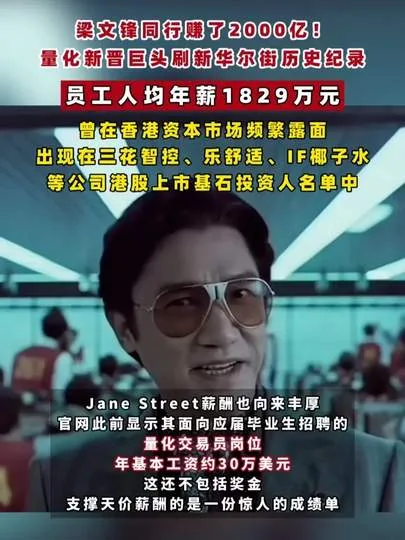
Let's put this in perspective, because the Chinese internet certainly is. Jane Street — the New York-based quantitative trading behemoth most normals have never heard of — just posted annual profits that exceed the GDP of Iceland. They made more money in 2024 than Blockbuster earned in its entire existence. We're talking about a firm that started in a closet-sized office in 2000 and now prints cash at a rate that would make the People's Bank of China jealous.
The Toutiao comments section is a masterclass in Chinese internet reaction culture. Top-voted responses fall into three camps:
Camp 1: The "Why Can't We Do That?" Crowd — These are the patriots, the tech nationalists, the ones who've been mainlining headlines about DeepSeek (深度求索) and Alibaba's Qwen (通义千问) and want to know why Chinese quant firms aren't putting up these numbers. The answer, of course, is complicated — capital controls, market structure differences, regulatory constraints — but that doesn't stop the soul-searching. "We have the math talent, we have the AI models, where's our Jane Street?" is the general vibe.
Camp 2: The Cynics — "Of course they made 200 billion. They're basically a casino where the house has a PhD in stochastic calculus." This crew sees quant trading as inherently parasitic, extracting value without creating any. There's a distinctly Chinese flavor to this critique — it echoes the periodic crackdowns on 「资本无序扩张」 ("disorderly capital expansion") that have haunted Chinese tech firms since 2021.
Camp 3: The Recruiting Realists — These are the ones checking LinkedIn. Jane Street is legendary in Chinese math-and-CS circles for paying fresh graduates from Tsinghua (清华大学) and Peking University (北京大学) starting packages that would make Tencent (腾讯) executives weep. We're talking $400K+ total comp for 22-year-olds. The brain drain is real, and this headline just poured gasoline on it.
Here's why this matters beyond the schadenfreude: China's quant trading industry is actually booming, but it operates in a very different universe. Domestic players like 幻方量化 (High-Flyer Quant), 九坤投资 (Ubiquant), and 明汯投资 (Worldquant's Shanghai-born cousin, not actually affiliated) have been posting eye-watering returns of their own. High-Flyer in particular has been making waves — not just for trading prowess, but because they spun off DeepSeek, the AI lab that's been terrifying Silicon Valley with its ultra-efficient language models. The quant-to-AI pipeline is real, and it runs both ways.
The Jane Street headline lands at a particularly sensitive moment. Chinese markets have been volatile. The property crisis drags on. Youth unemployment remains a sore subject. And here comes this American firm — staffed partly by Chinese-born math olympiad champions — casually announcing it made enough money to buy every unit in multiple Shanghai luxury apartment complexes. Combined.
What the Chinese internet is really wrestling with isn't jealousy. It's the algorithm economy question. China has spent a decade building world-class AI labs, training millions of STEM graduates, and developing domestic chips like Huawei's Ascend (昇腾) series. The strategic bet has been that AI supremacy translates into economic supremacy. Jane Street's numbers are proof that the translation works — just maybe not in the way Beijing planners envisioned.
The irony? Jane Street's secret sauce isn't just raw compute or proprietary models. It's market structure. They operate in the most liquid, deepest capital markets on Earth — US equities and derivatives. Chinese quant firms, no matter how brilliant their algorithms, face a shallower market, stricter position limits, and the ever-present risk that regulators will simply... change the rules. (Ask anyone who was running a CTA strategy in China during the 2024 futures crackdown.)
There's also a delicious cultural tension here. Chinese social media loves a rags-to-riches story — look at the obsession with livestream-commerce kings like Dong Yuhui (董宇辉) at East Buy (东方甄选). But quant trading riches feel different. They're abstract, algorithmic, seemingly divorced from the 「努力就有回报」 ("hard work pays off") narrative that underpins so much of Chinese internet culture. You can't hustle your way to stochastic dominance. You either have the Sharpe ratio or you don't.
The smartest take I saw on Toutiao came from a user who pointed out that Jane Street's $28 billion isn't just a number — it's a signal. It says the global financial system's plumbing has become so complex that only algorithmic traders can consistently extract alpha. And it says that the gap between human intuition and machine-optimized markets is now a chasm measured in billions.
For China's AI industry, currently locked in an existential race with US labs, the subtext is uncomfortable. The best Chinese math minds are either building language models for $40K/year at a domestic AI lab or writing pricing algorithms for $400K/year at a New York hedge fund. Until that compensation gap closes — or Beijing makes leaving significantly harder — the brain drain will continue, one optimized trade at a time.
The Jane Street headline will fade from Toutiao by tomorrow. But the uncomfortable questions it raised about talent, markets, and who actually captures the value of mathematical genius — those are going to linger a lot longer than any trending topic.