Giant Tank Blocks Highway for 8 Hours, China Can't Look Away
Something fell off a truck in China this week, and by "something," I mean a colossal cylindrical tank the size of a small apartment building. The resulting traffic jam strangled a highway for nearly eight hours. Eight. Hours. That's a full workday spent staring at a rogue metal cylinder while your dashcam footage slowly goes viral on Toutiao (今日头条), where it racked up over 843,000 engagements and counting.
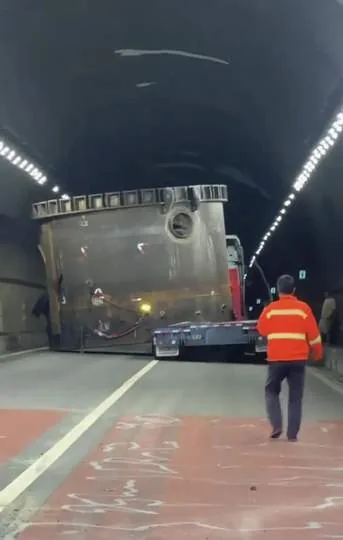
Let's set the scene. A large flatbed trailer — the kind that hauls industrial equipment across China's vast highway network — was transporting what appears to be a massive pressure vessel or storage tank. At some point, the cargo decided it had had enough of horizontal life and made a break for freedom. The tank rolled off the truck and planted itself in the middle of the road like the world's least helpful monument.
Now, in many countries, this would be a local news item, maybe a traffic update on the radio. In China, it becomes a national spectacle.
The logistics of removing a fallen industrial tank are genuinely nightmarish. You can't just push it. You can't lift it with a standard tow truck. You need specialized heavy-lifting equipment, which first has to navigate through — you guessed it — the traffic jam caused by the tank itself. It's a recursive nightmare, a logistical ouroboros. Authorities reportedly spent hours figuring out how to extract this metal beast without damaging the road surface or, you know, causing an even bigger disaster.
The number tells you everything: 843,468 hot-board points on Toutiao. That's not just casual interest. That's the Chinese internet collectively bonding over shared infrastructure trauma.
Here's why this resonates so deeply: traffic is the great equalizer in China. Whether you're a tech mogul in Shenzhen or a factory worker in Dongguan, whether you're driving a Wuling (五菱) microvan or a Porsche, when a giant tank falls on the highway, you're all stuck together. It's democratic in the most frustrating way possible.
China's highway network is the world's largest, stretching over 177,000 kilometers. The country moves mind-boggling volumes of freight — over 50 billion tonnes annually. The sheer scale means that when something goes wrong, it goes wrong spectacularly. A single incident can cascade across regional supply chains. Those eight hours weren't just inconvenience; they were delayed shipments, missed connections, truck drivers burning through their legally mandated rest hours, and fresh produce slowly losing its freshness.
The Chinese internet's obsession with these moments reveals something fascinating about digital culture. On platforms like Douyin (抖音) and Weibo (微博), there's an entire genre of content built around infrastructure failures, logistics disasters, and road chaos. Dashcam footage is catnip for algorithms. People film the jam, film themselves waiting, film the tank, film the crane eventually arriving to remove the tank. It's participatory journalism born from sheer boredom.
The comments sections on these stories are where the real culture lives. You get the gallows humor — "the tank wanted to explore the world" — mixed with genuine frustration about logistics standards. People debate whether the truck driver properly secured the load, whether the transport company should lose its license, whether highway design could be improved. It's crowdsourced accident investigation with Chinese characteristics.
There's also a class dimension. China's roads are shared by everything from massive articulated lorries to tiny electric scooters. When a giant industrial tank falls off a truck, it's a visceral reminder of the industrial behemoth coexisting uneasily with everyday civilian life. The trucking industry is under immense pressure to deliver fast and cheap. Corner-cutting happens. Securing a massive tank properly takes time, skill, and equipment. Not everyone bothers.
The viral nature of these incidents also reflects China's ongoing relationship with infrastructure. The nation built its highway network at breakneck speed — the pride of economic development. But maintenance, safety standards, and operational discipline haven't always kept pace. Every fallen tank, every collapsed bridge, every overturned truck becomes a Rorschach test for public confidence in the systems that keep the country moving.
Eight hours is an eternity in modern China, where same-day delivery is expected and logistics companies like Meituan (美团) and JD.com (京东) have trained consumers to expect precision. The contrast between the promise of frictionless commerce and the reality of a giant metal cylinder just sitting there on a highway is too perfect not to meme.
The broader pattern is clear: mundane disasters dominate China's trending feeds because they're relatable, visual, and slightly absurd. They cut through the noise of carefully curated content and algorithmic recommendations. A tank fell off a truck. Nobody was hurt. The road was blocked. Life went on. But for one bright moment, the entire Chinese internet paused to collectively ask: "How do we move this thing?"
Some questions have no easy answers. Some just need a really big crane.