Orange Isle Ticket Stampede Goes Viral—China's QR Code Hunger Games
Picture this: thousands of tourists, shoulder to shoulder on a river island, all thrusting their phones skyward like they're trying to catch digital manna from heaven. Every single screen glowing with the same QR code scanner. Fingers twitching. Eyes locked. This is the scene that just exploded across Toutiao (今日头条) with over 8.3 million views—the kind of viral moment that crystallizes everything about modern Chinese consumer culture in one breathtaking, slightly terrifying image.
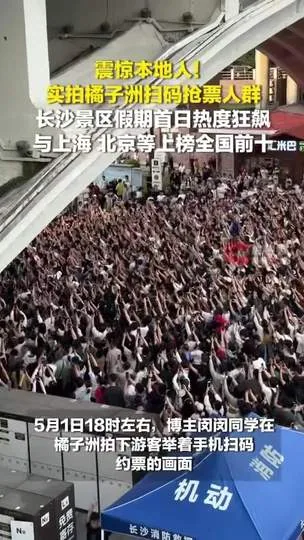
Welcome to Orange Isle (橘子洲), the iconic 5A-level scenic spot sitting pretty in the middle of the Xiang River in Changsha, Hunan Province. It's home to that massive young Mao statue that every Chinese tourist has photographed from exactly 47 angles. And this past week, it became the stage for what can only be described as a mass ritual of digital desperation.
The headline says it all: 「橘子洲游客齐刷刷扫码抢票太震撼」—roughly, "Orange Isle tourists uniformly scanning codes to snatch tickets is absolutely stunning." Over 8.3 million people watched this unfold. And yeah, stunning is the right word, though maybe not in the way the original poster intended.
Here's what's actually happening: China's domestic tourism boom has reached such insane volumes that even with advanced digital ticketing systems, securing a spot at popular attractions has become a competitive sport. Orange Isle implemented a reservation system—which, in theory, should make things orderly and civilized. In practice? It's turned thousands of visitors into a synchronized QR-code-scanning flash mob, all hitting "confirm" at the exact same millisecond when tickets drop.
This is not a glitch. This is China's consumer economy operating exactly as designed.
Let's zoom out. China's domestic tourism market hit roughly 6 billion trips in 2024, generating something north of 5.7 trillion yuan (about $790 billion). That's not a typo. The post-pandemic revenge travel wave never really crashed—it just evolved into a permanent state of hyper-mobility. And the infrastructure? It's both the solution and the problem.
See, platforms like Meituan (美团), Douyin (抖音), and the mini-programs embedded in WeChat (微信) made it trivially easy to book anything anywhere. The friction is gone. Which means everyone and their grandmother can attempt to book the same 30,000 daily tickets to Orange Isle at precisely 8:00 AM when the system opens. What you're watching in that viral video isn't chaos—it's the physical manifestation of cloud computing hitting human bodies.
This scene echoes something deeper in Chinese consumer psychology: the 抢 (qiǎng) mentality. "Snatching" is embedded in the DNA of Chinese e-commerce. Singles' Day flash sales, limited-edition Pop Mart (泡泡玛特) drops, concert tickets for any C-pop act with a pulse—it's all the same adrenaline loop. The QR code swarm at Orange Isle is just the offline, physical-world expression of something that happens millions of times per second on Taobao (淘宝) and Pinduoduo (拼多多).
And here's the uncomfortable truth that nobody in China's tourism apparatus wants to admit: the "smart tourism" revolution, with its AI-powered crowd management and big-data reservation systems, has in some ways made the experience more stressful, not less. When everything is optimized, the optimization itself becomes the competition. You're not just trying to visit a park—you're trying to out-compute thousands of other humans for the right to exist in that space for a few hours.
The Douyanization of physical spaces is complete. Tourism destinations now operate with the same logic as livestream commerce events hosted by figures like Dong Yuhui (董宇辉) at East Buy (东方甄选)—artificial scarcity, countdown timers, and a built-in audience that's been conditioned to pounce. The fact that Orange Isle is a public park with free admission for the basic areas makes this even more absurd. The paid attractions and guided tours within the scenic zone have somehow created a FOMO economy inside what should be a leisurely stroll.
What's genuinely fascinating is the aesthetic of the video itself. That drone shot of hundreds of people, phones raised in unison, screens glowing—it looks like a religious ceremony. Or a dystopian startup launch event. The visual symmetry is genuinely striking, which is why it blew up. Chinese netizens aren't sharing it because they're outraged; they're sharing it because it's aesthetically compelling and mildly horrifying in equal measure. The top comments on Toutiao ranged from "this is why I don't travel during holidays" to nostalgic laments about simpler times when you could just... walk into a park.
The county-tier tourism boom (县域旅游) that's been trending hard on Xiaohongshu (小红书) was supposed to distribute the pressure—send people to smaller, less-crowded destinations. And to some extent it has. But the marquee 5A sites like Orange Isle, West Lake, and the Forbidden City remain gravity wells that suck in disproportionate crowds. No amount of algorithmic cleverness changes the physics of physical space.
So what's the takeaway? China's consumer infrastructure is so advanced that it's created new forms of collective anxiety. The QR code stampede at Orange Isle isn't a failure of technology—it's technology working perfectly in an environment of infinite demand and finite supply. It's the physical world straining under the weight of digital efficiency. And it's wildly entertaining to watch from a distance.
Next time you're stuck in a virtual queue for concert tickets or refreshing a product page at midnight, remember: at least you're not standing on a river island in Changsha, arm raised among thousands, praying your 5G connection is 0.3 seconds faster than everyone else's. Or maybe you are. In which case, good luck out there. You're gonna need it.