Rust Is the New Battery: China Bets Big on Iron Oxide
Here's a sentence nobody expected to type in 2025: rust is having a moment. Not the metaphorical kind — not "China's rust belt" or industrial decline optics. Actual, literal, reddish-brown iron oxide — the stuff that eats old bicycles — is trending across the Toutiao (今日头条) hot board with a scorching 14.4 million engagement score, all because someone figured out how to turn corrosion into a grid-scale battery.
The headline — "铁锈凭什么成为储能尖兵," roughly "Why Rust Has Become the Vanguard of Energy Storage" — sounds like a clickbait riddle. It is not. Chinese materials scientists have been quietly advancing iron-oxide-based energy storage for years, and the story has finally broken through to mainstream feed consciousness. The question the headline poses is genuine: how did the most unglamorous substance on earth become a darling of the storage revolution?
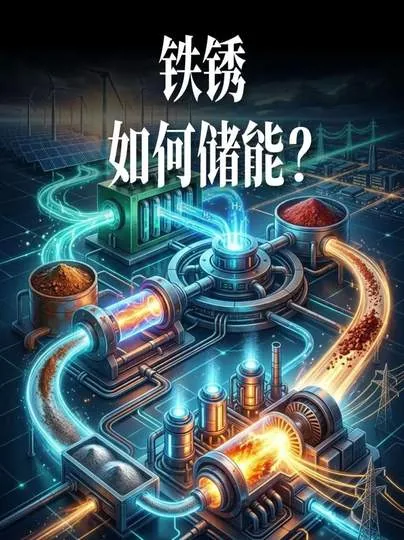
The answer, as usual, is chemistry and cost.
Iron oxide — Fe₂O₃ if you're nasty — can serve as an electrode material in certain battery architectures, particularly iron-air and iron-flow designs. The concept isn't new globally: companies like Form Energy in the United States have been chasing iron-air batteries for years, promising multi-day storage at a fraction of lithium-ion costs. But China's angle is different. Rather than treating rust as a clean-sheet lab invention, Chinese researchers and companies are looking at the country's massive iron and steel industrial waste streams and asking a very practical question: what if we can upcycle millions of tons of iron-oxide-rich slag, mill scale, and pickling waste into functional storage materials?
That circular-economy framing — turning industrial waste into green-tech feedstock — is catnip for Chinese industrial policy. It hits every note: resource efficiency, domestic supply chain security, cost competitiveness, and a satisfying narrative about turning decay into power. No wonder Toutiao users are clicking like mad.
Let's talk numbers. Lithium carbonate prices in China have been a rollercoaster — spiking to nearly 600,000 yuan per ton in late 2022 before crashing below 100,000 yuan in 2024. That whiplash has made grid operators and renewable energy developers extremely motivated to find alternatives for stationary storage, where weight and energy density matter less than raw cost per kilowatt-hour and cycle life. Iron-oxide-based systems theoretically deliver storage at a fraction of lithium costs — some estimates put iron-air chemistry at under $20 per kWh of capacity, compared to $80-120 for current lithium-ion systems.
Iron is abundant. Iron is cheap. Iron doesn't require importing lithium from Australia, cobalt from the DRC, or nickel from Indonesia. For a country that imports roughly 70% of its lithium feedstock and has made supply chain self-sufficiency an article of faith, that math is irresistible.
What's revealing here is the Chinese internet's relationship with hard industrial science. In Western tech media, a story like this would get buried under ten thousand AI agent startup announcements. On Toutiao, a headline about iron-oxide electrochemistry can out-trend celebrity gossip and consumer product launches. There's a genuine appetite among Chinese readers for deep-tech content — materials breakthroughs, process innovations, manufacturing scale-up stories — that feels almost quaint compared to the vapidity of much of Silicon Valley's discourse.
This connects to a broader pattern. The same Chinese internet that melts down over Pop Mart (泡泡玛特) Labubu drops and Dong Yuhui (董宇辉) livestream drama also passionately engages with stories about solid-state battery progress, perovskite solar cell efficiency records, and now rust-based storage. The feed doesn't compartmentalize "serious tech" from "fun stuff" the way Western platforms often do. A materials science explainer and a hotpot-brand controversy can sit side by side on the hot board, and both get genuine engagement.
The iron-oxide story also reveals something about how Chinese innovation narratives are constructed. The framing isn't "lone genius in a lab." It's industrial ecosystem alchemy — connecting steel mills, battery manufacturers, materials institutes, and grid operators into a coherent value chain. The hero isn't a startup founder; it's the system. That's a fundamentally different innovation story than the one Silicon Valley tells itself, and it's one global observers should understand better.
My take: the hype is directionally correct even if the timeline is fuzzy. Iron-based storage won't replace lithium-ion in phones or — to avoid the banned topic — certain mobility applications. But for grid-scale, multi-hour-to-multi-day storage attached to solar and wind farms? Rust could genuinely be the dark horse. China has the steel waste, the electrochemistry talent, the manufacturing scale, and the policy incentives to make this real. The 14.4 million Toutiao readers clicking on an iron oxide explainer might be onto something that Wall Street hasn't priced in yet.
The next time you see rust on a neglected railing, remember: in China, that's not decay. That's inventory.