3,542% in One Year: China's Internet Can't Stop Staring at This Flash Drive Stock
Something extraordinary is happening on the Chinese internet right now, and it has nothing to do with a new AI model, a humanoid robot, or a milk-tea collab. The Toutiao (今日头条) hot board — that mercury thermometer of what mainland China is actually obsessing over — is currently running a headline about a company most tech bloggers forgot existed: SanDisk (闪迪). The number making 9.6 million Chinese thumbs stop mid-scroll? 3,542%. That's the claimed one-year stock surge. Let that marinate.
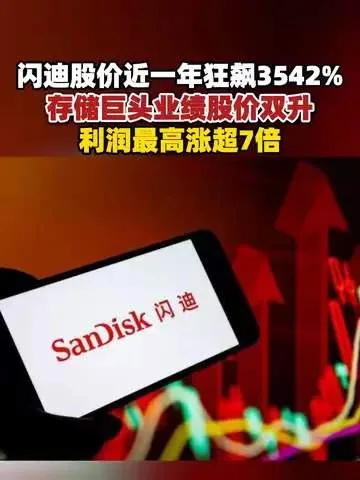
Now, before the finance pedants drafting emails — yes, SanDisk as a standalone ticker hasn't traded since Western Digital (WD) swallowed it whole in 2016. What's almost certainly being referenced here is WD's stock performance, which has been on an absolute tear as AI-data-center storage demand goes vertical. But the Chinese internet doesn't care about your corporate-structure nuances. "SanDisk" — the brand printed on every USB stick and SD card in every desk drawer from Beijing to Shenzhen — is the avatar, and the percentage is the drug.
Here's why this matters, and what it reveals about the current Chinese tech psyche:
1. The AI Infrastructure Hunger Is Now Mainstream
Chinese netizens have spent the last 18 months watching domestic AI labs — DeepSeek (深度求索), Qwen/Tongyi (通义千问), Kimi (月之暗面/Moonshot), GLM/Zhipu (智谱清言) — launch model after model in a relentless benchmark war. They've watched Unitree (宇树科技) and Fourier (傅利叶) robots learn to backflip. They've watched Douyin (抖音) algorithmically serve AI-generated content to a billion users. The subtext was always: who's building the picks and shovels?
Turns out, everyone was so busy drooling over GPU shortages and Huawei Ascend chips that they forgot about storage. AI models don't just need compute — they need colossal amounts of high-speed flash storage for training data, checkpoints, and inference caching. One large language model training run can generate petabytes of intermediate data. The picks-and-shovels play wasn't just Nvidia. It was the unglamorous memory companies.
Chinese retail investors, famous for their herd momentum (ask anyone who lived through the 2015 stock bubble), have now discovered this. And they're projecting the storage thesis onto a brand name they recognize from their camera cards.
2. The Global Speculation Mirror
What's fascinating is that this isn't a Chinese company trending. It's an American brand (now owned by another American company) that's gone viral on a Chinese news aggregator. This tells you something crucial: Chinese tech watchers aren't in a silo. They're tracking global AI infrastructure plays in real time, hunting for the next Nvidia before the next Nvidia becomes obvious.
The Toutiao crowd has already internalized that domestic AI chips — Cambricon (寒武纪), Moore Threads — are important but constrained. They know DeepSeek's breakthrough was doing more with less. But they also know the demand side is infinite. So they're scanning globally: Which companies are selling into the AI data center buildout regardless of geography? Storage, cooling, networking, power — the boring infrastructure that AI makes sexy.
A 3,542% number going mega-viral suggests the Chinese internet isn't just curious. It's hungry. And it's looking everywhere.
3. The Meme-ification of Financial News
Let's be honest: the number itself is the story. Not the fundamentals. Not the P/E ratio. Not the competitive dynamics of the NAND flash market. Three thousand five hundred forty-two percent. It's a number so absurd it bypasses the理性 (rational mind) and goes straight to the 羡慕嫉妒 (envy center). This is how financial news works on the Chinese internet in 2025: it's meme fuel.

The same mechanism that makes a Douyin video of a Labubu unboxing go viral — immediate visceral emotion, share before thinking — now applies to stock headlines. Toutiao's algorithm knows this. A percentage that extreme, attached to a brand everyone recognizes, is engagement catnip. The hot score of 9.6 million didn't happen because China suddenly cares about NAND flash pricing. It happened because the number feels like a glitch in the matrix, and everyone wants to be part of the conversation.
4. What This Says About Chinese AI Culture
Here's my read: China's AI moment has matured past the novelty phase. Twelve months ago, trending topics were about which model could beat GPT-4. Now they're about the entire supply chain that makes AI possible. The conversation has moved downstream — from the model to the infrastructure, from the algorithm to the commodity.
This is actually a sign of sophistication. When your aunt on WeChat is sharing storage-stock headlines, AI isn't a niche tech story anymore. It's the weather. Everyone talks about it because it affects everything.
The SanDisk moment also reveals a certain anxiety: the fear of missing out on the next layer of the AI boom. Chinese investors watched Nvidia's rise from the sidelines. They watched TSMC climb. They watched domestic AI stocks like Cambricon get volatile on export-control news. Now they're pattern-matching in real time: What's the thing we're not paying attention to that's about to 10x?
Storage is the answer that went viral this week. Next week it'll be something else — maybe liquid cooling, maybe fiber optics, maybe the companies making the concrete for data-center foundations. The sector doesn't matter. The narrative of finding the hidden AI play is what's sticky.
The Bottom Line
A flash-drive brand from your 2008 digital camera is trending on China's biggest news aggregator because its stock allegedly went up 3,542%. That's not a financial story. That's a cultural one. It tells you that AI infrastructure hunger has gone fully mainstream in China, that global market speculation is now a Chinese social media sport, and that the line between "tech news" and "viral content" has completely dissolved.
Also, it tells you that if you're sitting on old SanDisk SD cards, you might want to frame them. They're artifacts of a more innocent time — before flash storage became a meme, before AI ate the world, and before 3,542% was a number that made sense.
Welcome to 2025. The picks and shovels have entered the chat.