China's "God Wei" Just Won Big — And The Internet Is Crying Happy Tears
If you've spent any time on the Chinese internet over the past three years, you already know the man carrying the 1.5-liter plastic water bottle. That's Wei Dongyi (韦东奕) — Peking University (北京大学) math professor, walking meme, accidental folk hero, and now a recipient of the Second-Class National Natural Science Award (国家自然科学奖二等奖). The headline trended at over 10 million heat on Toutiao (今日头条) this week, and honestly? The whole country needed this win.
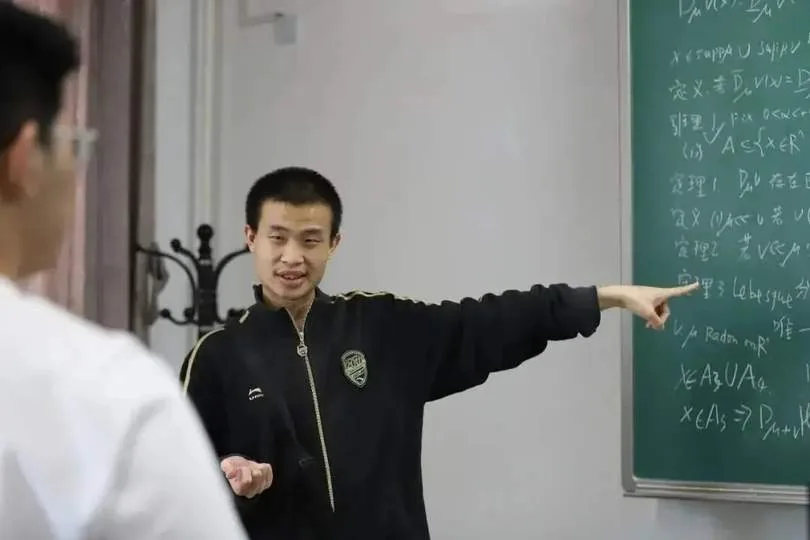
For the uninitiated: Wei Dongyi became internet famous in 2021 when a campus reporter stopped him for a man-on-the-street interview. The then-postdoc shuffled into frame with a cheap thermos, a plastic bag full of steamed buns, and the energy of someone who had genuinely forgotten that cameras exist. He mumbled a few sentences about encouraging students to study hard and wandered off. The clip exploded. Douyin (抖音), Weibo (微博), and Bilibili (B站) collectively lost their minds. Overnight, "God Wei" (韦神) was born — a nickname that's half-reverent, half-self-deprecating, and entirely sincere.
Here's the thing that made the whole thing irresistible: the man is genuinely, almost impossibly, brilliant. Gold medals at the International Mathematical Olympiad — twice, with perfect scores. PhD at Peking University. Research in harmonic analysis and partial differential equations that made actual mathematicians sit up and pay attention. While influencers were doing dance trends and selling milk tea franchises, Wei was solving equations that maybe forty people on Earth fully understand.
The internet's love affair with him was always about more than just memes. In a feed economy saturated with plastic surgery ads, livestream millionaires, and C-pop stars whose talent is... debatable, Wei Dongyi felt like an antidote. He carried a reused water bottle. He wore clothes that looked like they lost a fight with a washing machine in 2017. He didn't seem to care about being perceived, and that made him impossible to look away from.
So when the National Natural Science Award announcement dropped — the country's top honor for basic research — the response was immediate and emotionally loaded. "God Wei deserves this," wrote one Weibo user with the intensity of someone whose favorite team just won the finals. "This is the real China we should be bragging about," wrote another. On Xiaohongshu (小红书), tributes mixed with gentle jokes about whether the prize money would finally convince him to upgrade his thermos.
What's actually happening here is more interesting than the feel-good narrative. China has been pouring staggering resources into basic science — math, physics, fundamental AI research — as part of a strategic pivot away from application-layer dominance toward the foundational stuff that actually determines who controls the next technological era. The National Natural Science Awards are the public-facing scoreboard for that push. First-class prizes are famously rare; second-class is serious recognition.
Wei's win lands at an interesting cultural moment. Chinese AI labs like DeepSeek (深度求索), Alibaba's Qwen (通义千问), and Zhipu's GLM (智谱清言) are in a global benchmark war. The country's robotics players — Unitree (宇树科技), Agibot (智元), Fourier (傅利叶) — are racing from demo videos to actual deployments. Behind all of that is math. The kind of math Wei Dongyi does. The trend isn't subtle: this is a society deciding that abstract brainpower is national infrastructure.
But here's my honest read on why this story specifically went nuclear: Wei Dongyi is permission. He's permission for a generation raised on "hustle culture" and "side gigs" to believe that it's still okay — maybe even noble — to care about one strange, unmarketable thing with your whole heart. He's proof that the system, at least occasionally, still rewards the actual geniuses and not just the best self-promoters. In a Chinese internet culture that has spent the last decade optimizing for virality, conversion rates, and "personal branding," God Wei is the anti-influencer. He went viral anyway.
The irony, of course, is that he never asked for any of this. Every indication suggests Wei would be perfectly happy solving PDEs in obscurity with his discount water bottle and his steamed buns. He didn't chase fame; fame found him because the internet, apparently, still has a soft spot for the real thing.
China's tech story is usually told in terms of scale — billions of users, millions of servers, factories that spit out humanoid robots like they're microwave ovens. But sometimes the most revealing data point is a single mathematician trending at 10 million heat for winning an award most people can't even pronounce. The country is watching. The country cares. And somewhere in a modest office at Peking University, God Wei is probably already back to work, wondering what all the fuss was about.