Zhang Linghe Fan Melee Exposes China's Celebrity Chaos Problem
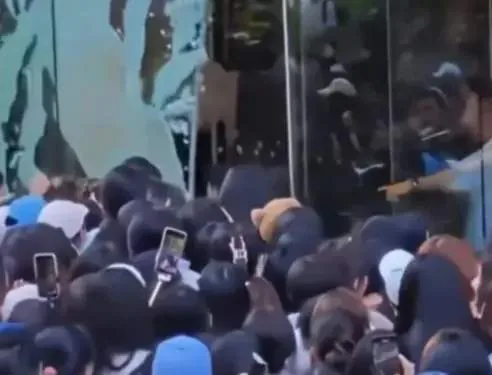
The Chinese internet is having a collective meltdown over what should have been a routine celebrity appearance—but ended up looking more like a stampede at a free hotpot giveaway. Zhang Linghe (张凌赫), the 26-year-old actor who exploded to fame after starring in the 2023 hit drama "The Story of Pearl Girl" (珠帘玉幕), showed up at a brand event recently, and the scene immediately went sideways. We're talking fans surging past barricades, security visibly overwhelmed, and the kind of chaos usually reserved for Black Friday door-buster sales or the last day of a Pop Mart (泡泡玛特) Labubu drop.
The trending Toutiao (今日头条) headline—“张凌赫线下活动现场失控谁该反思” (“Zhang Linghe's offline event spirals out of control—who should be reflecting?”)—has racked up over 3.5 million hot-score points, and it's not because Chinese netizens are genuinely concerned about crowd safety. They're doing what the Chinese internet does best: weaponizing a spectacle to settle scores, debate systemic failures, and dunk on everyone involved.
Here's what actually matters here, and what it tells us about the state of Chinese celebrity culture in 2024.
The Incident (What We Know)
Details are still filtering through Douyin (抖音) and Weibo (微博), but the core narrative is simple: Zhang appeared at a promotional event—reportedly for a beauty brand partnership—and the crowd response was immediate and unhinged. Videos circulating on Bilibili (B站) show fans breaking through barriers, screaming themselves hoarse, and generally creating the kind of environment where someone getting trampled felt inevitable rather than possible.
Zhang, to his credit, reportedly tried to calm the crowd, but when you've got hundreds of people in a hormonal frenzy over a 6'2" actor with jawline sharper than a Huawei Ascend chip, one man's gentle pleas aren't moving the needle.
Security was, by all accounts, outmatched. This isn't surprising. Chinese event security for celebrity appearances often consists of a few exhausted staff members and some velvet ropes—the organizational equivalent of bringing a toothpick to a gunfight.
Why This Blew Up (Beyond Just Chaos Content)
But here's where it gets interesting, and why this particular incident has transcended standard "crazy fan" content to become a genuine trending topic with staying power.
First, Zhang Linghe is currently at the center of what Chinese entertainment media calls a "traffic" (流量) phenomenon—he's one of those rare actors whose every move generates massive engagement. His rise from relatively unknown to A-list happened fast, driven by algorithmic recommendation engines on platforms like Toutiao and Douyin that identified him as catnip for the 18-35 female demographic. When your fame is built on viral velocity rather than decades of craft, the fanbase that comes with it tends to be... intense.
Second, this incident touches on a raw nerve in Chinese celebrity culture: the question of responsibility. The Toutiao headline doesn't ask "what happened"—it asks "who should reflect." This is classic Chinese internet discourse framing. It's not enough to observe chaos; you must assign blame.
And oh, the blame is flying in every direction.
The Blame Game (Five Factions, Zero Agreement)
On Weibo, at least five distinct camps have emerged:
Camp 1: Blame the fans. These are the "quality over quantity" types who argue that real fans maintain composure. They're posting side-eye emojis and lengthy threads about "fan quality" (粉丝素质), a concept that treats proper crowd behavior as a marker of moral character.
Camp 2: Blame the organizers. This faction argues that brands and event companies consistently underprepare for celebrity events, treating security as an afterthought rather than a core budget item. They've got receipts—lists of previous events where similar chaos occurred, because this is absolutely not the first time.
Camp 3: Blame the celebrity/team. Zhang's management team is catching heat for not properly anticipating the crowd size and failing to coordinate with venue security. The argument: if you're managing a star with this much drawing power, crowd control planning should be your job one.
Camp 4: Blame the system. The meta-commentators who argue that China's entertainment industry has created a toxic feedback loop where extreme fan behavior is implicitly encouraged because it generates the metrics (数据) that determine celebrity value. When your entire industry runs on engagement numbers, you're financially incentivized to foster obsession.
Camp 5: Blame everyone, blame no one, just enjoy the drama. The nihilists of Xiaohongshu (小红书) who've turned the whole thing into memes. They're not wrong to treat this as entertainment—because that's exactly what it's become.
The Real Story: China's Fan Economy Has Outgrown Its Infrastructure
Here's what none of the hot takes are really grappling with: China has built a celebrity-industrial complex that moves faster than its support systems can handle.
The Chinese "fan economy" (粉丝经济) is estimated to be worth over 100 billion RMB annually. Platforms like Toutiao and Douyin have created recommendation algorithms so sophisticated that they can manufacture celebrity virality with surgical precision. Zhang Linghe didn't just happen to get famous—he was identified, promoted, and amplified by systems designed to create exactly the kind of intense, engaged fanbase that showed up at this event.
But the physical infrastructure hasn't kept pace. Event security protocols, venue capacity planning, crowd management expertise—these are still operating on assumptions from five years ago, when celebrity events were smaller, tamer affairs.
When you combine algorithmically supercharged fandom with old-school event management, you get Zhang Linghe standing behind a collapsing barricade looking like he's regretting every life choice that led him to this moment.
The Uncomfortable Truth
Nobody's going to "reflect" their way out of this. The Toutiao headline asks who should be doing soul-searching, but the answer is: the entire ecosystem.
Brands need to invest in proper security instead of treating it as a discretionary expense. Celebrity management teams need to demand better conditions. Platforms need to acknowledge that their engagement-obsessed algorithms are creating real-world consequences. And yes, fans need to understand that being devoted doesn't require being dangerous.
But most importantly, Chinese entertainment needs to have an honest conversation about whether its current model—where celebrity value is measured entirely by fan intensity—is sustainable. When your industry rewards the kind of passion that leads to stampedes, you're going to keep getting stampedes.
Until then, expect more headlines like this one. Zhang Linghe won't be the last celebrity watching his event spiral into chaos. He's just the current one.
And somewhere in Shenzhen, a Pop Mart executive is looking at those crowd videos and thinking: "We need to hire whatever security team they didn't use."